
Basketball betting odds in the UK: how the bookmaker's margin sits inside every price
 Available in US
Current as of November 4, 2026 — verified against the Gambling Commission’s public register and each operator’s own published terms.
A basketball betting odds price is a number with two jobs. It tells the bettor what a winning stake returns, and it tells the bookmaker what it keeps of every unit bet on the market. Those two jobs are in tension on every line on every NBA, EuroLeague or college game, and the gap between them is the cost the bettor pays for the privilege of having someone quote a price at all. This page is built around that gap: which bookmakers in Great Britain are licensed to take basketball bets, how their prices are put together, what the bonus headline really turns into once the wagering is done, and what the cost looks like across bet types, in-play markets and the long season ahead.

A short warning before the rest of it. Basketball is fast, the season is long, and the offers come thick. None of it removes the bookmaker’s margin, and the pages that suggest otherwise are selling a different product. The numbers that follow are what the operators and the Gambling Commission’s register report; the conclusions are the page’s own.
How the basketball betting market is built
How the game was built, and the fixtures it now plays (fixtur)
Basketball was invented by James Naismith in December 1891 in Springfield, Massachusetts. The first game, played on 21 December 1891 with a soccer ball and two peach baskets nailed to a gymnasium balcony, had eighteen men running after a ball that could not be dribbled. It has come a long way since. The modern men’s NBA schedule starts in October and runs through the play-offs into June, the EuroLeague plays out from October to May, the NCAA season runs from November to the first Monday of April, the international windows interrupt everything, and 3×3 has been an Olympic event since Tokyo 2020. The fixtures a UK bettor sees on a Monday evening in January and a Tuesday morning in May sit on top of that calendar, and a market that runs nine months of the year is a market where the price can be older than the team sheet.
The shape of the calendar matters to the price in three ways. First, the early-season book is built from last season’s numbers, with line-ups that may look nothing like the team sheet on the night — and the first six weeks of the NBA carry the highest margins for that reason. Second, mid-season trade deadlines, injuries and coaching changes produce line moves that look sharp only in hindsight; the book that opened the line on Tuesday cannot know the rotation on Friday. Third, the closing line of the season, where sharp money settles the last playoff price, is the most efficient number on the board and the hardest to beat. Most UK bettors look at opening lines and see them as the page, not as the start of a long conversation.
A few things about the fixtures that follow are worth getting on the page, because the betting market sits on them rather than next to them. The Olympic 3×3 format is half-court, ten minutes long, with a single made basket inside the arc worth one point and one from outside worth two. The NCAA March bracket has its own market rhythms: first-round favourites cover at a different rate than the round-of-thirty-two favourites, and the books know it. FIBA national-team windows produce games that bookmakers price thin because the rosters are unfamiliar. Every one of these calendars leaves a different margin in the price.
Fundamentals the betting line tracks — scoring, time and the court (fundamenta)
The basketball line follows the scoreboard, so the bettor who does not know the box score is reading the wrong end of the trade. Five players on court, unlimited substitutions at dead balls, a field goal worth two points inside the arc and three from beyond it, a free throw worth one, ten-foot (3.05 m) rims at almost every level, and a clock that runs four 12-minute quarters in the NBA or four 10-minute quarters under FIBA rules, with a five-minute overtime if the game is tied at the end. The total in a totals market is the product of those numbers, and a market set at 220.5 is saying it expects the two teams to score roughly 220 to 221 points combined. Two factors push that total higher: pace (possessions per 48 minutes) and efficiency (points per possession). A team that plays fast and shoots well pulls the total up; a team that plays slow and misses from outside pulls it down.

Three corollaries matter for the price. First, the spread — called the handicap in the UK — is set in whole or half points so there is no push: in a market priced at -7.5 the favourite wins the bet only if it wins by eight or more. Second, player-prop markets inherit the same fundamentals, so a points-line on a guard priced at 28.5 reflects minutes, usage rate and pace. Third, the quarter and half markets price the structure of the game: a team down by ten at half-time in the NBA has roughly thirty-six minutes to come back, and a third quarter in which the favourite outscores the underdog by eight points or more is a different market than the full game. Most lines on a basketball night are spread markets and totals, with moneylines taking the back seat for the obvious favourites — and that is where the margin of the menu matters, because the spread book is where the bookmaker has the most room to build a margin into the number.
Legality, licence and the point of consumption
A Great Britain licence is the starting point of any conversation about basketball betting odds in the UK, because there is no question of where to take a basketball bet in this country that does not run through the Gambling Commission’s public register. The regulator is a non-departmental public body sponsored by the Department for Culture, Media and Sport. It licenses the whole commercial market under the Gambling Act 2005, which covers England, Scotland and Wales (Northern Ireland runs on its own older law, so a GB licence does not regulate Northern Ireland and a Northern Irish licence does not regulate a GB customer). Since the Gambling (Licensing and Advertising) Act 2014, an operator whose remote facilities are used in Great Britain needs a Commission licence wherever it is based — a Curaçao, Maltese or Gibraltar licence is not a substitute. A licence covers one or more categories: remote general betting standard (real events), remote general betting standard (virtual events), remote general betting limited, remote pool betting and remote betting intermediary (the licence a betting exchange runs under). The Commission’s public register, searchable by business name, trading name, domain or account number, is the whole test of whether a brand holds a licence on the day a customer is about to deposit.
No statutory list of permitted sports or markets exists. The bookmaker holds a licence for a category and offers markets under its own rules and the Licence Conditions and Codes of Practice (the LCCP). Esports are treated like any other event; virtual events are a separate licence category; bets on politics, TV shows and novelty markets are offered by GB bookmakers and no statutory prohibition was found. The licence types carried by the ten operators reviewed on this page are listed in the comparison table further down; readers should check the register themselves, because the register is the only document that proves a brand’s licence on the day of the search.
The customer-side controls are equally specific. Minimum age 18. Name, address and date of birth are verified before a customer can deposit or gamble (since 7 May 2019), including with a free bet or bonus — which means no anonymous play is offered at any GB-licensed remote operator, even where the rest of the marketing page suggests otherwise. Credit cards are banned for gambling in Great Britain (since 14 April 2020), including credit-card-funded payments through an e-wallet; debit cards and bank-based payments are not. A British named-account rule, a state list of permitted payment methods and any rule for or against cryptocurrency deposits at licensed operators are not established by statute, and the section below on crypto and anonymity covers what the licensed operators’ terms do state on the point.
The tax position is the one that surprises readers who carry assumptions from other countries. The player pays no tax on betting winnings in Great Britain (general information, not tax advice; a professional gambler should ask HMRC or an adviser). General Betting Duty is the operator’s tax on gross profits, currently 15%. From 1 April 2027 a new remote betting rate of 25% applies within it, while remote bets on UK horse racing, bets on self-service betting terminals in licensed premises, pool betting and in-person betting stay at 15%. Spread betting has its own rates (3% financial, 10% other). Until 1 April 2027 the remote rate stays at 15%. Whether the operator passes duty on through the odds is not established; never write that the player is charged duty.
The enforcement frame closes the loop. Section 33 of the Gambling Act 2005 makes it an offence to provide gambling facilities in Great Britain without the licence the Act requires — aimed at the operator, not the customer. Enforcement is disruption, not blocking: cease-and-desist notices, search-engine referrals, work with registrars, hosts and payment providers, and court-order DNS blocking powers that have been given or are about to be given. A reader betting on a non-GB site does not commit a criminal offence under that section, but loses the layer of protection: no GAMSTOP coverage, no Commission complaints route, no approved dispute-resolution body, no British consumer redress if funds are withheld, and no obligation on the operator to apply the 10x bonus cap or the £150 vulnerability check. That is the trade — paid in compliance, lost in freedom, and the page describes both halves before the reader chooses.
Responsible gambling, financial checks and where help sits
GAMSTOP is the national multi-operator online self-exclusion scheme and a mandatory licence condition for online operators since 31 March 2020. Self-exclusion periods are six months, one year, five years, or five years with auto-renewal, and after the minimum period the exclusion stays in place for a further seven years unless the customer asks GAMSTOP to remove it. Online sites and apps are within scope; physical betting shops use a separate service. A customer who has self-excluded through GAMSTOP cannot open a new account at a GB-licensed online operator for the chosen period, regardless of how good the welcome offer is or how many times they re-register with new details. The compliance team of the operator runs the check on deposit.
A second licence condition runs behind the deposit button. LCCP condition 3.4.4, in force since 30 August 2024, requires a financial vulnerability check when a customer’s deposits minus withdrawals exceed £150 in a rolling 30-day period (effective 28 February 2025). It is a public-record check — looking at things like a county court judgment, an active debt relief order or a record of bankruptcy — not an income check and not a credit reference check. The operator who flags it cannot extend credit and cannot use the record for marketing; it is a flag against further play, not a conversation about the customer’s salary. The £150 figure matters: a recreational bettor who wagers within it is not in scope. A customer who crosses it once will usually be asked to confirm the rest of the trigger the next time it happens.
What is still on the way in matters more than what is in force, because it shapes the bettor’s planning. A second protection — financial risk assessments, sometimes called affordability checks in the press — was announced in a Commission article of 7 July 2026 on a staged plan with no start date. State that exactly: announced, staged, no start date. Deposit limits (RTS 12) also run on a staged plan: the first changes have applied since 31 October 2025, a second phase was postponed to 30 September 2026, and whether it is live is not clear. There is no state-set deposit or loss ceiling for sports betting at GB-licensed operators — the limit sits with the customer or with the operator’s risk team, and the rules around the customer-set one (a customer can set a daily, weekly or monthly deposit limit) are the customer’s first line of defence. Help services are not part of the LCCP framework but sit beside it: GamCare (the National Gambling Helpline), GambleAware, the NHS gambling clinics network, and Gamblers Anonymous all run free and confidential.
Two final notes. The client-side tools (deposit limits, time-outs, reality checks, product-block toggles) sit in the account settings of every operator on the comparison table below; readers should set them on day one rather than in a moment of regret. And the bettor who has stopped betting for any reason, including a single bad night, does not need to wait for a crisis to use GAMSTOP — the register is the route, and a six-month minimum is the shortest commitment the scheme offers.
Crypto, bitcoin and the question of an anonymous basketball bet
The licensed-British question on crypto is not “is it banned?” — because no statute bans a UK customer from holding bitcoin or any other cryptocurrency. The question on the page is “what does a GB-licensed basketball betting odds market look like to a bettor who arrives with crypto?”, and the answer is short. A licensed GB operator verifies name, address and date of birth before the first deposit, including for a free bet or bonus, under the customer-verification rules in force since 7 May 2019. That is the end of anonymity at the licensed desk: the deposit route can be anything the operator’s terms allow, but the account behind the deposit is on the operator’s KYC records from the first £1 in. Source-of-funds questions at higher spend are normal under the money-laundering rules, and at a GB-licensed operator they begin with the betting account and end with the financial records the customer has agreed to be asked for.
No GB-licensed brand on this page takes bitcoin or ethereum deposits through its own cashier. Several offshore operators (Curaçao, Anjouan, Panama and similar regimes) do take crypto at the cashier, and a customer who registers there gets to skip the GB KYC step — but loses every GB-licensed protection in the trade. No GAMSTOP coverage at the offshore site, no Commission complaints route, no approved dispute-resolution body, no British consumer redress if funds are withheld, and the operator is not bound by the 10x bonus cap or the £150 vulnerability check. Where the local exchange rate bites between the bitcoin deposit, the bitcoin bet and the bitcoin withdrawal, the bettor carries the slippage without recourse.
The cost angle that sits underneath the framing matters. Crypto-funded accounts solve a payment-rail problem some readers have (a bank block on gambling transactions, a no-fee wallet, an inheritance held in coin), and they add a new one (exchange-rate risk on the way in and on the way out, network fees on the transfer, no local-rules safety net). For a bettor whose bank will not process a MasterCard gambling transaction the offshore route can look like the only one. The honest statement of the trade is the same in this paragraph as it is in the legality section: licensed means checks, limits, GAMSTOP, the bonus cap; unlicensed means none of those and a possible loss of funds, with nothing in between.
Bonuses, free bets and the real cost of the offer
The first thing to clear out of the way: a “free bet” is almost never a refund in money when it wins, and the words “free”, “risk-free” and “guaranteed” on a welcome page are marketing language rather than a description of what lands in the customer’s account. The pages do not print bonus codes on this site — the figures below are what the operators’ own terms state, and the reader should treat the headline as the start of a sentence the operator finishes in the small print.
What the headline always buries, in basketball and elsewhere, is the wagering requirement. A bonus at a GB-licensed sportsbook has carried a wagering cap of 10x since 19 January 2026, on rules issued under the LCCP and the Commission’s bonus condition (a £10 bonus at a historic 50x required £500 of bets; under the 10x cap the requirement does not exceed £100 of qualifying bets on a £10 bonus, and the same principle extends across the bonus size). Mixed-product promotions — an offer that requires gambling on two or more product types such as betting, casino, bingo or lottery — are banned since the same date, so the era of “bet on football to get free spins” is over at a GB-licensed operator. What the cap does not do is make a bonus free; it caps the cost the operator can build into the small print.
A worked illustration helps, on a market the page has data for. Take a £10 bonus with a 5x wagering requirement (a moderate example, below the cap), placed in £10 single bets on a balanced basketball two-way market at decimal odds 1.90/1.90 — the page’s own example market, worked further down under “How the margin lives inside the price”. The required turnover is £50 (5 × £10). At a margin of 5% on the principal market the expected cost of clearing is roughly £50 × 5% = £2.50. The bonus is £10, so the net value is approximately £7.50 — not the £10 the headline shows, and not “free”. Shift the wagering multiplier up to the cap and a £10 bonus at 10x demands £100 of bets; on the same market the expected cost lands near £5 and the net value around £5. The “free” framing is what it costs to advertise the offer, and the math is what the offer really costs.
A free bet carries its own arithmetic. Where the stake is not returned with the win — and that is the default at every GB-licensed operator whose terms are public — a £10 free bet on decimal odds 6.00 pays back £50 in profit on a win (free bet × (odds − 1)) and pays nothing at all on a loss. The expected value of the free bet depends on the probability of winning and the payout share of the market at those odds. A free bet used on a long-priced outcome can clear more on a win than a short-priced one, but the win rate falls. Welcome offers often include an expiry (a seven-day window is a common figure in the GB free-bet market), and minimum-odds clauses can rule out the markets a basketball bettor actually wants to bet on. Read the terms, count the multiplier, set the calendar.
A second, smaller cost sits in the bonus structure. Where the welcome offer combines a sports bet and an accumulator bonus on the same headline (a £5 sports bet and a £5 acca on the same £10 trigger, for example), the two halves clear on different rules. The sports £5 carries the wagering and minimum-price terms the operator sets; the £5 acca may carry a higher minimum number of legs or a different price floor. A reader who treats the offer as £10 of bonus rather than £5 + £5 may finish half the rollover they thought they had. The headline is rarely the contract.
Apps, mobile and the in-hand betting slip
The mobile app is where the basketball betting odds price turns into a transaction. App considerations that show up in the GB market in 2026 fall into four groups. The first is range: how many basketball leagues the in-app menu shows in a single scroll. The National Basketball Association, the WNBA, the EuroLeague, the Spanish ACB, the Italian LBA, the Greek league, the Turkish Super League, the Israeli Super League, the Australian NBL, the Basketball Champions League, the NCAA and the latest FIBA windows are the menus a UK bettor expects to find; a thin list means thin markets. The second is live: in-play markets on every NBA game in-season, with at least the spread and the total adjusted after every quarter break. The third is the bet builder: the same-event accumulator that lets a bettor stack a moneyline, a total, a player-points line and a quarter handicap into one slip. The fourth is the cash-out button, which sits as a feature of mobile speed.
Two app details matter because they are not equally available across the comparison set. First, partial cash out (settle a portion of the stake at the current price, leave the rest on) is offered at one or two brands in this comparison and absent at most of the others; where it is offered, it changes the in-play strategy, because the bettor can lock part of a position without closing the full bet. Second, push alerts for line moves on followed leagues — “Lakers spread shortened from -3.5 to -4.5” — are useful if and only if the operator’s price feed is fast enough to make a trade against the move; a delayed feed turns the alert into entertainment. One operator in this comparison is described as the most-downloaded sports-betting app in the United Kingdom; that is a distribution figure, not a price-quality figure, and the download number carries no comment on the margin of the markets.
A note on browser-based betting. The same licence covers browser and app, and the same customer-account rules apply. The mobile app is faster for in-play trading because the push channel and the cash-out button are usually one tap closer to the live price than on a browser tab. The browser is usually faster for bet-builder construction, because a wider screen holds more leg-editing real estate. The price is the same on both routes at any licensed operator; the difference is in the seconds the bettor has to click.
Live basketball betting and where cash out changes the picture
Live basketball betting is where the menu and the marketing come closest together, and where the bettor is closest to paying for the privilege. The markets offered in-play on a single NBA game include the next-points scorer, the next scoring play (a field goal or a free throw), the result of the current quarter, the spread and total adjusted after every quarter break, race-to-X-points markets and player-props sequenced by scoring events. The first quarter of an NBA game is fast enough that the bookmaker’s price feed updates inside the play rather than at the quarter break, and the in-play margin on the principal markets is wider than the pre-match one. Plan on a margin roughly one to three percentage points higher on the in-play book than on the same market priced before tip-off, with the exact spread depending on the operator’s in-play engine and the liquidity of the event.
Cash out carries its own cost line. The price the operator offers on a cash-out button is the operator’s quote of what the bet is worth right now; the difference between that quote and the fair mid-point of the market is the cash-out margin. A bet that started at decimal odds 2.00 and is now at fair odds 1.50 will cash out at something inside that 2.00-to-1.50 corridor — usually closer to the operator’s unfavourable side, because the cash-out price is the operator buying the bet back from the customer and the spread is the operator’s reward for taking the rest of the trade. Where the operator offers partial cash out, the per-stake cost is the same — the customer is just choosing how much of the original stake to settle at the same unfavourable price.
Two in-play details the table below does not show. First, the markets that survive a stoppage are markets on the full game (spread, total, moneyline); the per-quarter markets and per-half markets settle at the break and do not re-open for in-play trading within the same window. Second, the Bet Builder product that combines markets from one event into a single bet is offered as a single bet pre-match and partially in-play at one or two of the operators reviewed below, with the in-play availability depending on the operator’s bet-builder engine. A bettor who treats in-play as a different product from pre-match is closer to the truth than a bettor who treats it as the same product on a different clock.
Basketball betting predictions, tips and strategy
A short section, deliberately. The page does not pick teams, name winners or sell a system, because no one knows who will win the next basketball game. What the rest of the page can do — and does — is describe what an honest prediction workflow looks like, where its cost sits, and where it stops being analysis.
Three layers of input are available to a bettor who wants to forecast a basketball game. The first is public information: team sheets, injury reports, pace statistics, offensive and defensive efficiency, rest days, travel, the home-court record in night games versus afternoon games, the foul-trouble profile of a key player, and the head-to-head since the line-up changes of the off-season. None of this is hard to find; the question is whether it prices into the line already. The second is the closing line: as a season settles into its rhythm, the line on each game closes where the most-informed money has settled it, and beating that line consistently is the test a bettor who bets for profit is up against. The third is information that is not yet priced: injury news that surfaces after the closing line, a starting-line-up change that the team announced on social media ten minutes before tip-off, the precise weather effect on a shooter’s three-point accuracy in a particular arena. That is where the sharp money lives, and most recreational bettors do not have access to it before the line adjusts.
The cost of being wrong sits inside the page’s broader arithmetic. The book’s margin on a balanced two-way market sits around 5%, on the moneyline of a heavily favoured NBA team it can be 3% to 4%, on an obscure European league with thinner liquidity it can be 8% to 12%. A bettor’s edge has to clear the margin before it is a profit, and a forecast that is genuinely right 55% of the time on a 1.91/1.91 market is roughly breaking even after the margin; one right 56% of the time is making a thin margin of profit. Anything below that is paying for the privilege of being wrong with statistical confidence. Staking discipline matters as much as selection: a flat one-unit stake across bets is the easiest way to make the math legible, and a varied stake relative to a perceived edge is the easiest way to lose without knowing.
Bankroll rules that have held up across the public record sit in the same paragraph. One unit per bet as a default. A daily stop-loss. A weekly review of which markets produced profit and which produced a paying-for-entries record. No chase, no upgrade after a losing streak, no parlay on the credit card because the bankroll says no. The strategies that look clever in print — progressive staking, hedge ladders, martingale variants — burn the bankroll they were supposed to protect, and the books know it. The page does not sell them.
Bet types, the price ladder and the margin it hides
A basketball betting odds price ladder runs through five families of market, and the margin is different on each.
The moneyline (called the outright winner in the UK, the moneyline in the US) is the simplest market: one of two teams wins, the price is decimal odds, the settlement is binary. On a close NBA game the moneyline carries the book’s lowest margin — typically 3% to 4% on a balanced pair of outcomes where the favourite is priced around 1.60 to 1.80 and the underdog around 2.40 to 2.60. The margin climbs with imbalance, and an NBA game where one team is priced at 1.10 against 7.00 carries a margin closer to 7% to 8%.
The spread — the handicap in the UK — is the most-used market in basketball. It is set in whole or half points, with no pushes; a -7.5 spread means the favourite wins the bet only if it wins by eight or more. The margin on a balanced spread is roughly 4.5% to 5.5%, slightly above the close moneyline because the public loads the favourite on the spread and the book builds a wider price-line to compensate.
The total (over/under on the combined score) is the third leg of the menu, set in half points, settled at the end of regular time, with overtime counting in some markets and not others. Margin is similar to the spread, 4.5% to 5.5%, with quarter and half totals sitting higher (6% to 7%) because the price feed is thinner on a within-game window.
Player props — points, rebounds, assists, three-pointers made, combination markets — are the fourth family. They are quoted at half-point intervals in some markets and at integer or step intervals in others. Margin is higher because liquidity is lower, with 6% to 9% common on the principal player-points markets of a marquee NBA game and considerably higher on rotation-player markets of an obscure league.
Combination bets — the same-game multi or bet builder — multiply the odds of the legs into one price, and the margin compounds at each leg. Two legs at 1.91/1.91 each produce a combined price of 3.65, but the per-leg margin sits inside both halves and the combined book carries the sum of both margins (closer to 9.8% on the combined market than 5% on a single market). A bet builder is a more expensive market than its single-market equivalent, and a bettor who wants a multi-leg position at single-market price finds it at a betting exchange rather than at the operator’s book.
The page’s worked example puts the principal-market math on the page. Take a balanced two-way basketball market at decimal odds 1.90/1.90 (fractional 9/10). The implied probability of each outcome is 1 ÷ 1.90 = 52.632%. Sum the two implied probabilities: 52.632% + 52.632% = 105.263%. The payout share is the reciprocal of that sum: 1 ÷ 1.05263 = 95.0%. The margin is 100% − 95.0% = 5.0%. Read the result as a band rather than a single figure: across UK-licensed basketball books, on a balanced two-way market with both sides priced near 1.90, the margin sits between roughly 4% and 6% depending on the operator’s pricing and the event’s liquidity, with the favourite-loaded and underdog-loaded ends of the menu carrying wider margins and the combination markets carrying the sum of all of theirs. State it as an estimate; it is the average over many bets, not a guaranteed outcome for any single one.
Statutes of the game — NBA, FIBA, college and the season structure (statute)
The rules of the game show up in the betting line. NBA games consist of four 12-minute quarters, FIBA games of four 10-minute quarters, and overtime periods at both levels last five minutes. A two-possession NBA game with five minutes to play has roughly the same clock time as a FIBA game with three minutes to play, and the pricing of a quarter or half market depends on which set of rules the game is being played under. Total-quarter minutes run 48 in the NBA and 40 in FIBA; the spread of a pace-heavy NBA team tends to be wider because more possessions produce more variance, and that variance is what the spread market is trading.
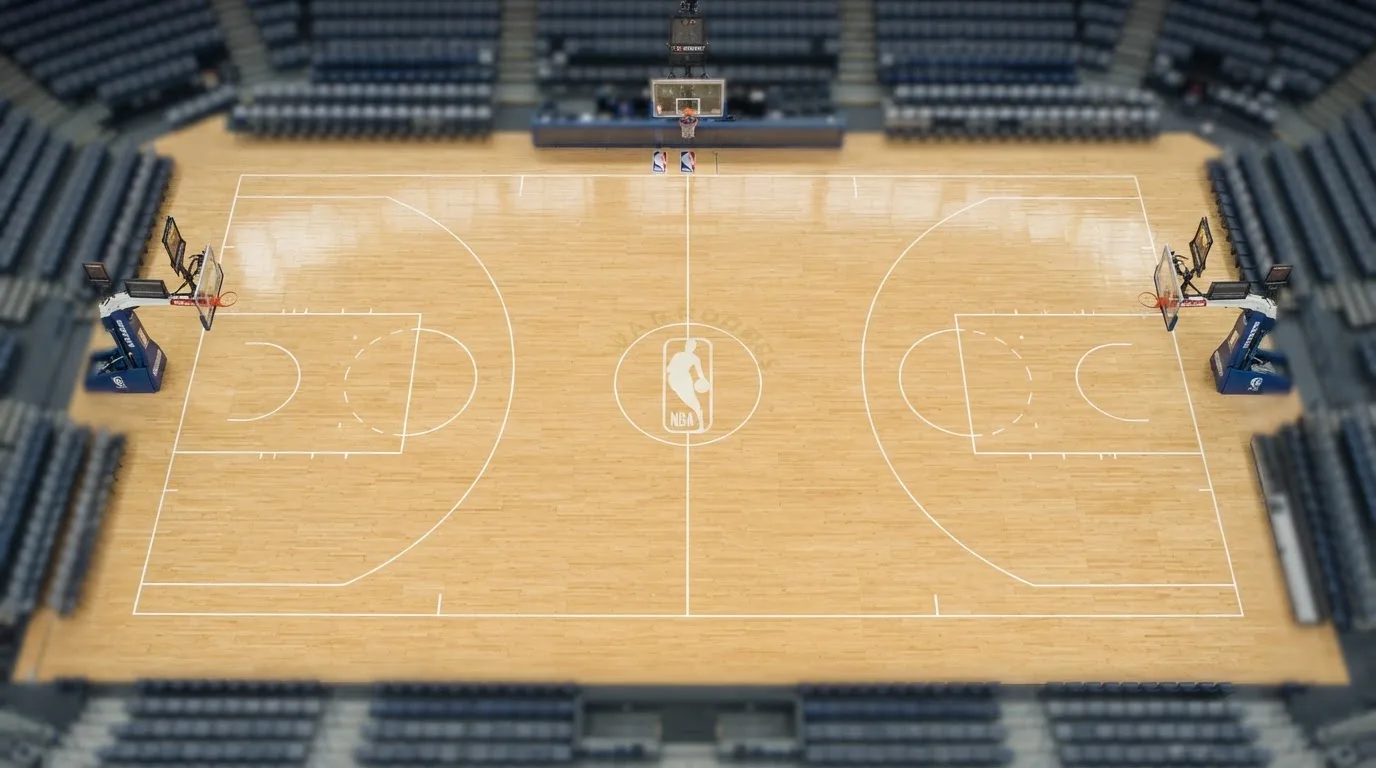
Five more rules shape the price. First, the substitution rules: a basketball team has five players on court at any time, with unlimited substitutions during stoppages. A star player in foul trouble or a coach who chooses to rest a back-court rotation can change the pace of the game within a single quarter, and the in-play book does not always re-price it cleanly. Second, the three-point line: a field goal is worth two points inside the arc and three from beyond it, with a free throw worth one. The number of three-point attempts a team takes drives its variance and its ceiling, and a team on a streak from outside looks unbeatable for stretches in a way the line does not always credit. Third, the foul rule: at six fouls in a quarter (NBA) or five fouls (FIBA), a team enters the bonus and sends the opposition to the free-throw line on every non-shooting foul, which lengthens games and inflates totals late. Fourth, the rim height: 10 feet (3.05 m) at almost every level of competition, which standardises the geometry and the kind of shot that scores from it. Fifth, the timeouts and the final-two-minutes review: an NBA game in the last two minutes routinely sees ten minutes of clock time and four actual minutes of basketball, and totals on that window are a different market than totals on the rest of the game.
The historical record matters for what the books price. Men’s basketball was first included at the 1936 Berlin Olympics; women’s basketball entered at Montreal 1976; 3×3 has been an Olympic event since 2020. The professional era in the UK is thin — the British Basketball League runs a season that ends in front of modest crowds and modest betting interest — and most of the betting volume on British customers’ slips is on the NBA, the EuroLeague, the Spanish ACB and the NCAA. The Olympic tournament runs every four years at full international basketball (5-on-5, FIBA rules) and 3×3 runs alongside it; both carry pricing in the bookmaker’s menu during the tournament window and disappear between them.
The calendar that matters for a UK bettor in 2026 is straightforward. NBA: regular season October to mid-April, play-offs mid-April to late May, finals in June. EuroLeague: October to May with a Final Four in May or June. ACB and the other major European leagues: similar calendar, slightly offset. NCAA: November to the first Monday of April (the bracket settles on Selection Sunday in mid-March). FIBA windows: short breaks in the NBA and European seasons, settled into the calendar. The books price the season, not the calendar year, and the season ends on a different date every year — which is why a date the page writes is always the operator’s season end, not the publication date.
The shortlist — ten bookmakers in the comparison
The comparison set is the ten operators below, each holding a Gambling Commission remote licence on the day the register was checked. The set is a shortlist, not a recommendation; a place in this comparison is not a licence, and a licence is not the same as a price-quality ranking. The shortlist is ordered as research routes it; readers comparing the brand profiles should think about which features matter to them, not which brand is “best” in some absolute sense. Two licences on this page sit with operators whose parent companies run more than one brand; never present brands from the same group as independent operators.
| Bookmaker | Gambling Commission licence and holder | Distinguishing offer or feature (operator’s own terms) |
|---|---|---|
| William Hill | Remote licence 039225-R-319373-015 (Commission account 39225); WHG (International) Limited | Best Odds Guaranteed on UK and Irish horse racing from 8am on the day, on single and multiple bets (excludes ante-post, tote, pari-mutuel) |
| Bet Ahoy | Remote licence 100094-R-341742-003 (Commission account 100094); Bet Ahoy Ltd | Welcome offer of a £5 sports bet plus a £5 acca for new customers placing a £10 first bet |
| Betfair | Remote licence 039439-R-319330-013 (Commission account 39439); PPB Counterparty Services Limited | In-play betting, Bet Builder, free in-app live streaming of UK and Irish racing and football, and a 90 Minute Payout market |
| Matchbook | Remote licence 039504-R-319407-024 (Commission account 39504); Triplebet Limited | Betting exchange: customers back and lay against each other, with Bet Builder, multiples, in-play and live horse racing and greyhound streaming |
| Star Sports | Remote licence 009177-R-104555-019 (Commission account 9177); Star Racing Limited | A trader-on-the-phone service (08000 521 321) for opening accounts, placing bets and queries, plus email support |
| Dabble | Remote licence 065677-R-340363-005 (Commission account 65677); Dabble Sports UK Ltd | Welcome offer of £10 in free bets on a £10 first deposit, with minimum odds, a seven-day free bet expiry, stake not returned |
| QuinnBet | Remote licence 061011-R-335683-004 (Commission account 61011); QuinnBet (Gibraltar) Limited | Best Odds Guaranteed on UK and Irish horse racing from 10am daily on singles, multiples and system bets, capped at £150 per customer per race |
| Spreadex | Remote licence 008835-R-104580-022 (Commission account 8835); Spreadex Limited | Fixed-odds and spread betting in one app, with partial cash out, Bet Builder across both formats and live streaming of NFL among selected sports |
| Bar One Racing | Remote licence 056516-R-332750-007 (Commission account 56516); Bar-One Racing Limited | An Irish independent bookmaker with shops across Ireland and racecourse sponsorships at Dundalk, Fairyhouse, Navan, The Curragh, Curraheen Park and Cork |
| BetTom | Remote licence 064959-R-339314-003 (Commission account 64959); Bet Tom Limited | Welcome offer of 50% back up to £50 as a free bet on sport, with a matching 50% up to £50 as free slot funds for casino |
Three notes sit beside the table. First, the licence number is the search key on the Commission’s public register; type it into the register’s business-name search and the operator’s full record appears. Second, the offering column reproduces what each operator’s own terms state; where the source is the operator’s own page rather than the App Store listing, the wording follows the operator. Third, the table does not state any welcome offer in a form that can be redeemed — no promo code appears here, and the headline on the operator’s own site is the only headline that can be redeemed against the book. A reader who wants the offer should open the operator’s site directly.
Each bookmaker in turn
William Hill
William Hill’s GB-licensed operation sits under WHG (International) Limited on the Commission’s register; the licence is remote general betting standard for real events. The brand is one of the longest-running names in British betting, with the institutional knowledge that comes from operating high-street shops through the post-2005 market consolidation. The bookmaker’s well-known feature — Best Odds Guaranteed on UK and Irish horse racing from 8am on the day, on single and multiple bets — does not run directly on basketball, and a basketball bettor looking at the brand is not buying into that horse-racing price promise. What the brand does carry, on basketball specifically, is a wide market range (the NBA, the WNBA, the EuroLeague, the ACB, the main European leagues and the NCAA during March), full in-play availability, and a bet-builder product that combines same-event legs into one slip. The price on close NBA games tends to settle near the average of the GB-licensed books on the comparison, not the tightest or the widest. The verdict for a basketball-first bettor: a mainstream GB book with a deep menu and average price, sitting behind a parent company that runs several other licensed brands in the same family. The best fit is a recreational bettor who already has a William Hill account from the horse-racing side and wants to add a basketball slip without a second sign-up.
Bet Ahoy
Bet Ahoy Ltd holds the licence under Commission account 100094. The brand is a newer GB-licensed sportsbook with a smaller profile than William Hill or Betfair, and its welcome offer — a £5 sports bet plus a £5 acca for a £10 first bet — is a useful test of the bonus cap: the structure is two halves, the sports half clears under the standard wagering rules and the acca half clears under different leg-count rules. The brand’s profile is closer to “niche GB sportsbook” than “mainstream GB sportsbook”, which means the menu is leaner than the major brands on the comparison but the price on close games sits close to the market average. Where Bet Ahoy’s profile trails the bigger books is live-streaming depth (the in-app offering is narrower than Betfair’s horse-racing and football streams) and customer-service channels. A competitive-price book whose welcome offer is well worth checking the small print on (the two £5 halves settle on different rules), it serves as a solid alternative for a bettor who prefers a lean menu and competitive pricing on niche markets.
Betfair
Betfair sits under PPB Counterparty Services Limited in the Paddy Power Betfair group, which means a Betfair Sportsbook account and a Paddy Power account are related in the corporate sense and unrelated in the betting sense. The licence is remote general betting standard for real events, and the brand’s profile carries the broadest feature stack on this comparison: in-play betting across all the major basketball leagues, a Bet Builder product, free in-app live streaming of UK and Irish horse racing and football (not basketball, as no broadcaster rights flow that way to a betting app), and a 90 Minute Payout market on selected football events. The basketball menu is one of the widest in the GB market, and the price on close NBA and EuroLeague games tends to sit at the tighter end of the GB-licensed range. It is the market leader for an all-round bettor who values deep-menu access and in-app streaming functionality.
Matchbook
Matchbook is a betting exchange, licensed as a remote betting intermediary under Triplebet Limited. That single fact changes what a basketball bettor is buying. There is no bookmaker on the other side of the trade; the bettor backs a price against other users, or lays the selection to other backers. The odds are tighter because there is no margin paying the operator, and the operator’s commission on net winnings is the only cost of using the book. The features — Bet Builder, multiples, in-play and live streaming of horse racing and greyhounds — are real, but the bettor reading the menu needs to know the exchange has a different shape than a sportsbook: liquidity can be thin on obscure leagues, the lay side of a market is its other side, and a poorly priced selection is left unmatched rather than accepted. It stands out as the exchange choice for a bettor looking to avoid bookmaker margin on every single trade.
Star Sports
Star Racing Limited operates the GB-licensed Star Sports brand, and the operator’s most distinctive feature is a trader-on-the-phone service on 08000 521 321 for opening accounts, placing bets and queries. That feature carries a meaning in 2026 it did not carry in 2010: most GB sportsbooks automate account opening, deposit and bet placement, and a customer can interact with the entire product on a handset. The phone line is a niche service for a customer who wants a human on the other end, and Star Sports has built its brand around being the kind of bookmaker where a trader at the end of a phone can take a request rather than route it through an app. The licence is remote general betting standard; the menu carries the standard basketball leagues; the price on close NBA games sits in the broader band of GB-licensed books rather than at the tight end. It is the premium selection for a bettor who values direct telephone contact with a trader over an automated app experience.
Dabble
Dabble Sports UK Ltd holds the licence, and the brand’s profile is the cleanest version of the GB-licensed new-entrant: a sportsbook with a £10 free-bet welcome on a £10 first deposit, a minimum-odds clause, a seven-day expiry on the free bets and the stake not returned on a winning free bet. That is the headline that appears in the operator’s terms, and the small print the page will not rewrite is the small print that turns the £10 into the bonus the customer actually clears. The brand carries the standard GB-licensed basketball menu (NBA, EuroLeague, ACB, NCAA during March and the major European leagues); the in-play book covers the major games. The verdict for a basketball bettor: a competitive-price GB-licensed new-entrant with a clear welcome structure, best suited to a customer who has compared the bonus cap (10x since 19 January 2026) and the seven-day expiry against their own betting week. The match is good for a customer placing one qualifying bet a week, less good for a customer whose betting calendar is shorter than the seven-day window.
QuinnBet
QuinnBet (Gibraltar) Limited holds the licence under the Commission’s account number 61011. The operator’s profile is built around horse-racing value (the Best Odds Guaranteed product from 10am daily on UK and Irish racing, capped at £150 per customer per race, on singles, multiples and system bets) and a wider sportsbook offering that covers the major basketball leagues. The brand is not a household-name GB sportsbook but carries a GB licence, a £150 BOG cap, and a basketball menu that runs the standard set of leagues. The price on close NBA games sits in the mid-band of GB-licensed books rather than the tight or wide end. This is the operator for a bettor who balances a regular horse-racing interest with a basketball market that is mid-band in its pricing.
Spreadex
Spreadex is the only operator on this comparison that combines fixed-odds and spread betting in a single app, and its licence is one of the older GB remote licences (Commission account 8835). Spread betting carries FCA regulation; fixed-odds betting carries Gambling Commission regulation; the product page makes clear that spread betting losses can exceed the deposit. The fixed-odds basketball menu runs the standard GB set; the spread product offers spread markets on points totals, quarter spreads and several other basketball lines where the bettor’s stake sizes a price-band rather than places a single fixed-odds bet. The cash-out feature is one-click, auto and partial — partial cash out is offered at fewer GB-licensed brands than full cash out, and Spreadex carries it. The verdict for a basketball bettor: the operator for a customer who wants fixed-odds and spread betting in the same account, with the trade-off that spread betting is a higher-variance product than fixed-odds and the loss can be larger than the deposit. The fit is a customer with experience in both products, not a customer new to spread betting.
Bar One Racing
Bar-One Racing Limited operates the brand as an Irish independent bookmaker, with shops across Ireland and racecourse sponsorships at Dundalk, Fairyhouse, Navan, The Curragh, Curraheen Park and Cork. The licence is GB remote general betting standard; the brand is an Irish-rooted bookmaker serving UK customers through its GB licence. The sportsbook menu carries the major basketball leagues at conventional depth, and the price on close games sits in the broader band of GB-licensed books rather than at the tight end. The brand’s distinguishing feature is its Irish shop presence and racing sponsorships; a basketball bettor who books with Bar One Racing is supporting an independent bookmaker whose racing tie is closer than its basketball tie. This is a choice for a bettor who supports independent operations and wants a basketball menu with an Irish-racing heritage attached.
BetTom
Bet Tom Limited holds the licence under Commission account 64959. The operator’s profile carries a sports welcome offer of 50% back up to £50 as a free bet, paired with a 50%-back-up-to-£50 free-slot-funds casino offer; the two halves of the welcome clear under different rules and the page does not re-state the small print. The brand is one of the newer GB-licensed books on the comparison; the menu runs the standard basketball leagues and the in-play book covers the major games. The price on close NBA games sits in the broader mid-band of GB-licensed books. The verdict for a basketball bettor: a competitive-price GB-licensed new-entrant whose welcome offer splits between sports and casino, best suited to a customer who bets on both product types and has set the bankroll around the casino side. The fit is weaker for a customer whose interest is basketball-only.
Frequently asked questions
How does a UK bettor place a basketball bet from a smartphone?
Open an account at a GB-licensed operator from the comparison above, complete the standard age and identity verification, deposit using a debit card or bank-based payment method (credit cards are banned for gambling in Great Britain since 14 April 2020), open the basketball tab, select a market and a price and confirm the stake. The bet is recorded in the account history and the cash-out price updates during the game if the operator offers it. A bettor who wants live streaming alongside the in-play bet needs the operator’s app installed; a browser-based bet is supported at every GB-licensed brand on this page.
Is betting on basketball online legal in Great Britain?
Yes, at a GB-licensed operator. The Gambling Commission licences the remote betting market under the Gambling Act 2005 and the Gambling (Licensing and Advertising) Act 2014; an operator whose remote facilities are used in Great Britain needs a Commission licence wherever it is based. The Commission’s public register is the search tool for whether a brand holds a licence on the day of the search. A GB licence does not regulate Northern Ireland, where the betting law runs on older statutes.
How is the return on a basketball bet worked out from the stake and the odds?
A basketball odds price is decimal. The total return on a winning bet is the stake multiplied by the decimal odds; the net profit is the stake multiplied by (odds minus 1). A £10 bet at decimal odds 2.50 returns £25 (a profit of £15); a £10 bet at decimal odds 1.50 returns £15 (a profit of £5). A combination bet multiplies the odds of the legs into one price: a three-leg acca at 2.00, 1.80 and 2.50 settles at a combined price of 9.00, and a £10 stake returns £90 (a profit of £80) on a win of all three legs.
What is the bookmaker’s margin and how does it show in the odds?
The margin is the share of every unit bet on a market that the bookmaker keeps on average. On a balanced two-way market priced at decimal odds 1.90 / 1.90, the implied probability of each outcome is 52.632%, summing to 105.263%, and the payout share is 95.0%; the margin is 5.0%. Across UK-licensed basketball books on a balanced market the margin sits in a band roughly between 4% and 6%, with the favourite-loaded and underdog-loaded ends of the menu carrying wider margins and combination markets carrying the sum of all of theirs.
Where does a customer get help if basketball betting stops feeling like entertainment?
GamCare runs the National Gambling Helpline; GambleAware funds treatment and information; the NHS gambling clinics network offers specialist support; Gamblers Anonymous runs peer-support meetings across the UK. GAMSTOP is the national multi-operator online self-exclusion scheme, mandatory for online operators since 31 March 2020, with self-exclusion periods of six months, one year, five years, or five years with auto-renewal, and a seven-year tail after the chosen minimum period. Account-side controls (deposit limits, time-outs, reality checks, product-block toggles) sit in every operator’s settings page and the customer can set them at any point, including on day one of opening an account.
US & other team sports – Inplayguide.com
Content created by the «Inplayguide.com» team
