
Badminton betting tips in 2026: a guide, not a tip sheet
 Available in US
Search results are full of “badminton betting tips” that promise winners. They can’t deliver them. A tip is a person’s view that one outcome is more likely than the price suggests; nothing fixes the result. This guide covers the work that earns a tip — how form and head-to-heads are read, why the bookmaker’s margin erodes every price, what a value bet really is, how bankroll discipline keeps a bad week from ending your betting — and where the British licensing frame stands around it.

The data below is current as of October 30, 2026 and has been checked against the Gambling Commission’s public register.
Statute: the British frame around any online badminton bet
Any operator taking bets from customers in Great Britain — England, Scotland and Wales — needs a Gambling Commission licence. The Gambling Act 2005 is the underlying statute, and the Gambling (Licensing and Advertising) Act 2014 closed the route by which an operator based abroad could serve British customers without one. The Commission sponsors itself under the Department for Culture, Media and Sport; it is the regulator, the licensing authority and the body whose public register is the single test of who is licensed.
Five licence categories cover the remote market a bettor in Britain meets: remote general betting standard (real events), remote general betting standard (virtual events), remote general betting limited, remote pool betting, and remote betting intermediary (the licence that exchanges such as betting exchanges sit on). A search of the public register by business name, trading name, domain or account number returns the holder, the categories on the licence and the licence status. The register is the only “is this licensed” check that carries weight, and it is open to anyone.
Northern Ireland sits outside the 2005 Act. A “Great Britain licence” or “GB-licensed” describes a Commission licence precisely; writing that a GB licence regulates Northern Ireland is the easiest mistake a betting page makes. The minimum age is 18. A licensed remote operator verifies name, address and date of birth before a customer can deposit or place a bet, and that rule has held since 7 May 2019 — including for a first free bet or promotional credit. Anonymous play at a licensed site is not available, by design.
What may be bet on is not set by statute. Operators define their own markets under the Commission’s Licence Conditions and Codes of Practice. In-play badminton is offered at licensed brands; whether a given in-play market runs on a given night depends on the operator’s own book and the data feed it carries. Esports are treated like any other event; virtual events sit under a separate licence category. Politics, TV shows and novelty markets are also offered by Commission-licensed brands, with no statutory prohibition. No statutory cap on stakes in sports betting was found anywhere in the Act — operators set their own maximum stakes and may restrict individual customers.
Spread betting sits in a different legal world. Financial spread bets are regulated by the Financial Conduct Authority, not the Commission; their losses can exceed the deposit. A spread book such as Spreadex carries dual permissions: FCA for the financial side, Gambling Commission for the fixed-odds side. The two should not be confused on a badminton page.
Wellbeing: the controls a licensed brand is required to give you
GAMSTOP is the national multi-operator online self-exclusion scheme. It has been a mandatory licence condition for online operators since 31 March 2020, and every brand reviewed below participates. Self-exclusion periods run six months, one year, five years, or five years with auto-renewal; after the minimum period the exclusion stays in place for a further seven years unless the customer contacts GAMSTOP to lift it. GAMSTOP covers online sites and apps; betting shops are run on a separate, over-the-counter scheme.

A financial vulnerability check has applied since 30 August 2024 under LCCP condition 3.4.4, with the customer-spend trigger live since 28 February 2025. It activates once a customer’s deposits minus withdrawals exceed £150 in a rolling 30 days, and the check is a public-record check (bankruptcy, county court judgments and the like) — not an income check, not a credit reference check. A second regime — the financial risk assessments the press calls “affordability checks” — was announced in a Commission article of 7 July 2026 as a staged plan, with no start date; write it as announced and staged rather than in force.
The safer-gambling toolkit operators are required to offer includes deposit limits on a fixed time frame, time-outs, product restrictions and self-exclusion, alongside reality checks and access to help services. From 31 October 2025 a first set of deposit-limit rules took effect; a second phase was postponed to 30 September 2026, and whether the second phase is currently live is not established. There is no state-set deposit or loss ceiling for betting — limits are the customer’s choice — and a licensed brand’s safer-gambling page is the place to set them.
Help lines sit alongside the controls. GamCare runs the National Gambling Helpline; GambleAware, the NHS gambling clinics and Gamblers Anonymous are the other named routes. A licensed brand’s safer-gambling page links to these. BeGambleAware, GamCare, GAMSTOP, Gambling Therapy and the Betting and Gaming Council are all named as routes on at least one major operator’s site.
Advertising and bonus rules that have tightened the offer
Two changes shape the bonus a bettor meets at a licensed brand today. First, wagering requirements on bonuses are capped at 10x — a £10 bonus carries no more than £100 of required betting, where the same bonus once came with a £500 turnover target. Second, mixed-product promotions are banned: an offer that asks the customer to bet on badminton to qualify for free spins on a slot, for example, falls foul of the rule.
How those rules read together: the headline-grabbing “100% bonus” of a few seasons ago is now harder to clear and harder to bolt onto another product. The cap is at 10x the bonus amount. Whether the cap extends to free bets that carry no wagering condition at all, and whether there is a money-value cap on a bonus, are not established on the public record. The promotion rules took effect from 19 January 2026.
Other advertising rules sit on a different track. The CAP Code (non-broadcast) and BCAP Code (broadcast) are enforced by the ASA. CAP Code section 16 sets the social-responsibility line: marketing must not be of strong appeal to under-18s, and no one who is or appears to be under 25 may feature gambling or take a significant role in a gambling ad (with an exception for marketing placed where a bet can be placed directly). That rule is about who may appear, not who may bet. The whistle-to-whistle ban on TV betting ads from five minutes before a live sports event to five minutes after it, before the 9pm watershed, is an industry code in force since 1 August 2019; horse and greyhound racing are excluded. The Premier League’s withdrawal of gambling sponsorship from the front of matchday shirts (from 2026/27, while sleeves and perimeter boards remain) is a club-led decision, not a law.
These rules affect what an offer looks like on the page. They do not soften the cost of clearing any bonus that remains. That is a separate calculation, in its own section below.
Bonus offers on badminton: what they cost underneath
A “free bet” looks like a gift. It is a stake paid in credit, the stake of which is usually not returned with a winning payout. A £10 free bet on a winner at decimal odds 3.50 returns £35 in profit — not £45, because the £10 stake is the book’s. A “bet £10, get £30 in free bets” headline costs the book £30 in marketing and the bettor the £10 stake on the qualifying bet, which itself carries the book’s margin.
A welcome bonus at a fixed percentage — “50% back as a free bet” — works the same way once you look at the small print. BetTom’s sports welcome, for example, returns 50% of the qualifying stake as a free bet up to a stated cap, alongside a matching 50% as free slot funds for casino play; “full terms apply” is the line where the wagering, minimum odds and expiry sit. A bet booster, an accumulator insurance that refunds a losing acca as a free bet, and a price boost each shift the price of a selection in the bettor’s favour; the cost sits in the margin that the boosted line carries, in the maximum stake the operator allows, and in any expiry or restriction on the boosted bet.
The harder question is the one below the surface: how much betting does the offer take to clear, and at what expected cost? That is the calculation the rest of this section runs. Where a bonus carries a wagering factor of, say, 5x on a £10 bonus, the required turnover is £50; the number of bets depends on stake per bet and the minimum price the operator enforces. Where the bonus stake itself is not paid back on a win, the value of the free bet is the free-bet amount times (odds − 1) divided by odds, multiplied by the payout share of the market it is used on. The expected cost of clearing the offer is required turnover times the margin of the market the qualifying and free bets are placed on. None of these quantities is a fixed rule across bookies; each operator’s terms give its own.
Live badminton betting and the cash-out mechanic
In-play betting turns badminton’s two-hour match window into a series of price changes. At licensed British brands in-play badminton is offered, with controls set by the operator’s licence conditions rather than by statute. A bettor watching the match can back the next-game winner at adjusted prices as the rally count moves, lay the favourite if momentum has shifted, or pull a pre-match bet back via cash-out before the final game settles.
Cash-out is not a separate market. It is a price the book offers to close the bet early, derived from the current state of the selection and the original odds; the operator’s margin sits inside the cash-out price too, and on average cash-out pays less than letting the bet run. Live streaming and in-play data feeds let the bettor react faster than a price ticker; tracking trackers — graphical trackers of rally-by-rally data — keep the picture accurate when video is not available.
The BWF tour runs on a packed fixture list. Live betting depends on a feed of in-play markets that operators with a strong racket-sports book tend to keep live; operators with a thin badminton book leave the market in pre-match only. The bettor’s choice is whether the operator’s in-play feed sits where the bettor wants to sit, which is a property of the brand and not a property of badminton.
What a “tip” actually is, and why none of them is certain
A tip is one person’s claim that an outcome is more likely than the price. Form — win/loss over the last several events, against opponents of comparable ranking — is the obvious starting point. Head-to-head records, surface and venue effects (some players travel better than others), the draw, recent injury news and any fatigue from the previous round, even the order of play on the day, all feed into a probability estimate. A tipster packages that estimate and states a selection; the reader’s job is to weigh the tipster’s reasoning, not just the pick.
A value bet is the price at which the bookmaker’s offered odds exceed the bettor’s estimate of the true probability. If the bettor’s model says Player A wins 60% of the time and the book offers 2.00 (decimal) — implying a 50% probability before margin — the bet is value by that estimate. The book’s margin is built into the price: at 1.90/1.90 the payout share across both sides is around 1 ÷ (1/1.90 + 1/1.90) = 1 ÷ 1.053 ≈ 0.95, or a 5% margin; the same mathematics at 1.80/1.80 returns about 1 ÷ (1/1.80 + 1/1.80) ≈ 1 ÷ 1.111 ≈ 0.90, or a 10% margin. The first set of prices is offering roughly 95 pence of every pound back to bettors on a fair result; the second set returns roughly 90 pence. Both can be value; the calculation is whether the price exceeds the bettor’s probability, and whether that probability is properly set.
The margin calculation is precise. Take a two-way market priced at decimal odds 1.90 and 1.90. The implied probability of each side is 1 ÷ 1.90 = 0.5263, or 52.63%. Added across both outcomes, the implied probabilities total 1.0526 — over 100% by 5.26 percentage points. The book’s margin is that excess. The payout share is the inverse: 1 ÷ 1.0526 ≈ 0.95, or 95 pence in the pound returned to bettors on a fair outcome (where the book broke even). The 5% band is what a tight sportsbook charges; the 8–12% band is what a niche-market book will charge on a market with thin liquidity.
This is the mathematics that makes “tips” slippery. A tip gives a probability estimate. The odds give another probability estimate. The margin sits between them. A tipster who never quantifies probability is selling words; a tipster who says “I make this 55% to win” can be tested against the price. Bettors who track their own closing line — comparing their estimate to the price they took — see where the margin quietly works against them. That tracking is the difference between a reader of tips and a punter who can call one.
A 5% margin on a turnover of £500 spent clearing a £10 bonus at 50x wagering makes the offer cost, on average, £25 in expected loss — and not less than that, and not more only if the margin on the qualifying market is in fact 5%. A 10% margin on the same turnover lifts the expected cost to £50. The cost moves with the price of the bets being placed; the headline “free bet” is the visible edge of that iceberg, not the iceberg.
Bankroll discipline and staking: why most tip followers lose
Bankroll is the float a punter sets aside for betting, kept separate from rent and bills. Staking is the rule that turns a tip into a bet: how much of the bankroll is risked per selection. Flat staking — the same unit stake per bet, often 1–3% of bankroll — is the standard against which Kelly-style staking systems are benchmarked; the Kelly criterion sizes the stake to the edge, but a half-Kelly or quarter-Kelly is the practical version because the true edge is rarely known.
A bad week at 3% per bet of a £500 bankroll costs £75. At 10% per bet the same week can halve the bankroll. The point of a staking rule is not to win more — it is to survive long enough for value betting to mean something. Punters who raise stakes after losses chase them back; punters who keep stakes flat see losing streaks as the price of admission to the long run.
Bankroll and staking work together with tip quality. A tip with a 5% edge at 1% stakes returns roughly 0.05% of bankroll per bet at fair resolution, before variance. A tip with no edge — which most tipsters carry, since most tipsters lose to the closing line in the long run — returns nothing, and the variance does the rest. The discipline is to log every bet, to know the closing line at placement, and to refuse to raise stakes to recover.
No model removes variance. A 100-bet sample at a 5% edge still has a standard deviation large enough that a confident reader can lose over the whole run by chance. The honest framing is statistical: a positive expected value is not a guarantee of a positive outcome.
The maths of a single badminton bet
A badminton match winner at decimal odds 2.10 with a £10 stake returns £21 on a win — the £10 stake plus £11 of profit — and loses the £10 stake on any other outcome. The calculation is stake × odds for return, profit = stake × (odds − 1).
That same match on a betting exchange, where the back price on Player A at 2.10 is matched by a lay price of around 2.12, lets a punter back or lay either side. A lay bet at 2.12 wins if Player A loses; the liability is stake × (odds − 1). Exchange rates and the betting-intermediary commission are the operator’s edge; the exchange sits in the same market as the bookmaker, with a different liquidity profile.
Each-way betting splits the stake into two equal bets: one on the win, one on the place, with place terms depending on the field size. A badminton each-way market is unusual; each-way is a horse and greyhound-racing staple, where place terms are operator-specific. On a BWF event an each-way offer is rare, and where one exists the place terms are the operator’s choice.
A badminton acca strings several selections together; the odds of the legs multiply into one price. A four-fold at 1.50, 1.80, 1.40 and 1.70 returns 1.50 × 1.80 × 1.40 × 1.70 = 6.426 times the stake. The catch is the same as in any accumulator: all four legs must win, and the book’s margin compounds across each leg rather than averaging out. An acca with four legs each at a 5% margin carries the book’s edge on each one, and any insurance or boost refund is a separate calculation.
Sports and tournaments: where the badminton calendar sits
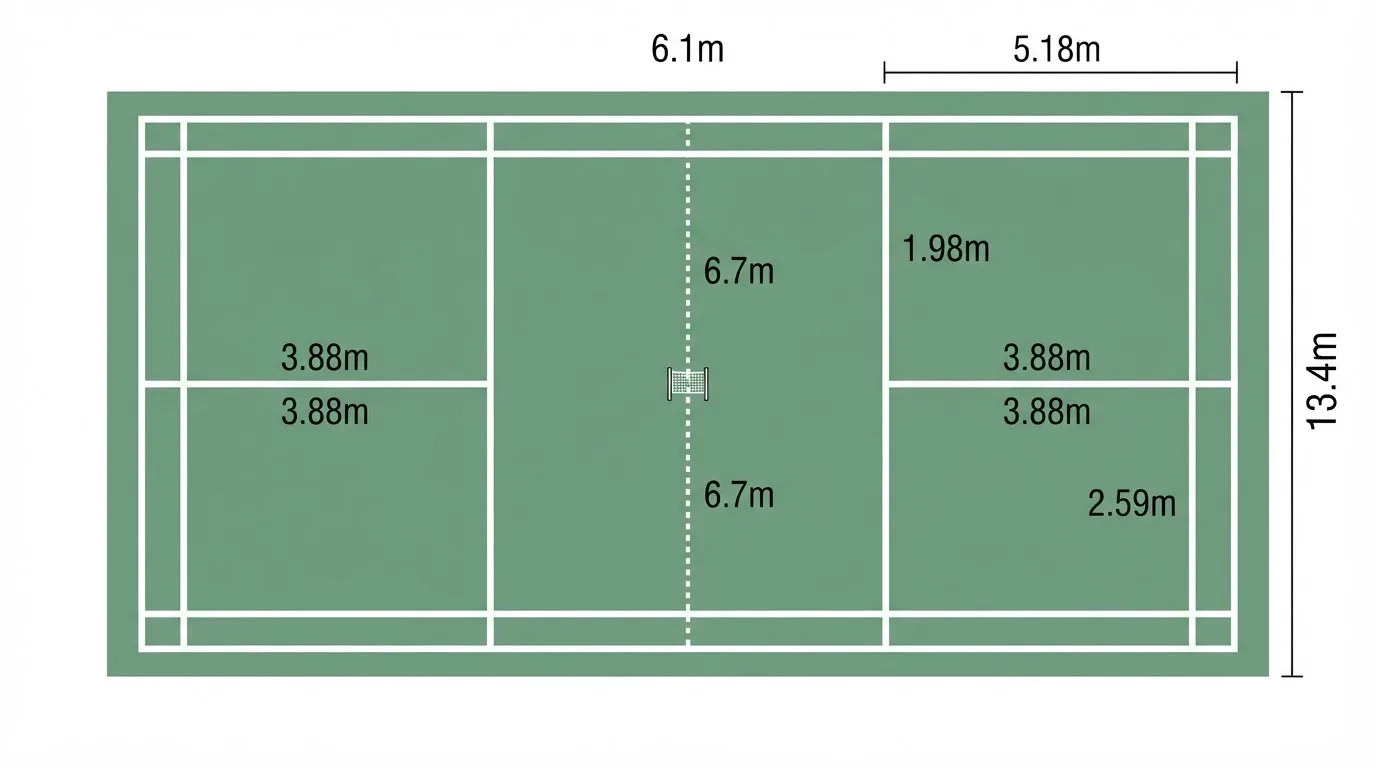
The Badminton World Federation (BWF), founded in 1934 as the International Badminton Federation, governs international badminton. Each game is played to 21 points with rally-point scoring, and a match is the best of three games; at 20–20 play continues until one side leads by two, and at 29–29 the next point wins. The court itself is 13.4 m long, 6.1 m wide for doubles and 5.18 m wide for singles, with a net 1.55 m at the edges and 1.524 m at the centre. Five disciplines cover the elite game: men’s singles, women’s singles, men’s doubles, women’s doubles and mixed doubles.
Badminton has been an official Summer Olympic sport since 1992, with mixed doubles added at the 1996 Games. The Thomas Cup (men’s team) and Uber Cup (women’s team) are held every two years, and the Sudirman Cup (mixed team), begun in 1989, sits on the same biennial rhythm. The All England Open Championships date back to 1900, making them the oldest of the modern tournaments, and the BWF World Championships have run since 1977. The BWF World Tour and its Super-series tier structure the rest of the year-round calendar; the season culminates in the BWF World Tour Finals.
Which of these the betting market carries depends on the operator. Major brands run outright winner, match winner, handicap and totals markets on the Super-series tier and on BWF World Tour Finals; they carry smaller BWF events with thinner pre-match depth, and very few run a deep in-play market on lower-tier events. Olympic badminton sits in its own bracket every four years, with outright, group and individual match markets opening roughly a year out from the Games.
How the licensed bookmakers stack up on the things this page is about
Ten Commission-licensed bookmakers that surface on a badminton search sit in the table below; each carries a remote general betting standard (real events) licence. A bookmaker’s licence number is its handle on the Commission’s register, and the holder named beside the licence is the legal entity behind the brand. Two brands may run under one licence holder — Ladbrokes and Coral under LC International Limited, for example — and they should not be presented as independent operators.
| Brand | Licence account number (Gambling Commission) | Licence holder | Position on the matters this page turns on |
|---|---|---|---|
| Ladbrokes | 54743 | LC International Limited | Price boosts on horse and greyhound bets, Best Odds Guaranteed on UK and Irish racing, in-play betting and Acca Boosts |
| Copybet | 53774 | Copybet UK Limited | Best Odds Guaranteed all day every day on UK and Irish racing, plus first-past-the-post payouts on horse racing even when the winner is later disqualified |
| BoyleSports | 39469 | Boylesports Enterprise | Acca Insurance with opt-in, a £5 minimum stake, 1/2 minimum odds and a £20 free-bet refund cap, expiring 7 days after issue; bets must be placed and settled the same day |
| BetTom | 64959 | Bet Tom Limited | Sports welcome offer of 50% back as a free bet up to a stated cap, paired with 50% back up to the same cap as free slot funds for casino play |
| Tote | 54779 | TDCO Limited | Pool-betting heritage; the Commission’s remote pool betting category sits alongside its general betting category on the licence |
| Swifty Sports | 58957 | Swifty Global (UK) Ltd | Best Odds Guaranteed, Cash Out across horse racing and football, daily price boosts, live streaming and in-play; Bet Builder listed as coming soon |
| Fitzdares | 400 | Fitzdares Limited | Cash Out, accumulators, Lucky 15s, ante-post markets on horse racing, football, tennis, rugby, cricket, golf and American football, with in-play live odds |
| Betmaster | 65699 | BM Solutions GB Ltd | A small, recently licensed brand; licence holder registered in Malta, badge carried on its UK site |
| Bet600 | 44731 | Tyche Tech Limited | Best Odds Guaranteed on horse racing: if the starting price is bigger than the early or show price taken, the bet is paid at the starting price |
| bet365 | 55148 | Hillside (UK Sports) ENC | In-play betting and live streaming of events worldwide, plus Bet Track, Match Live and a Live Golf Tracker for following bets in play |
The matter column is deliberately about the feature each brand names first in its own marketing. A reader scanning for live badminton coverage in particular will treat Swifty Sports, bet365 and Fitzdares as the operators that name in-play explicitly; a reader scanning for acca features will see BoyleSports, Fitzdares and Ladbrokes at the top of that list. “Best Odds Guaranteed” is on horse and greyhound racing at every brand that names it; a reader who reads “Best Odds Guaranteed” into badminton pricing on the strength of this table alone has misread it, and the table does not support the inference.
The ten brands at a glance, and the reader each one suits
Ladbrokes
The best-known legacy bookmaker on the list. LC International Limited holds the licence; Ladbrokes and Coral run under the same holder and the same product on the website. Best Odds Guaranteed on UK and Irish horse racing, in-play betting on the major sports, and Acca Boosts. The deep markets are on football and racing rather than on badminton, and on a typical week the badminton in-play grid runs at the marquee BWF events only. Ladbrokes suits a punter whose betting portfolio is built around racing and football, with badminton as one of several sports along for the ride; readers who want extensive BWF coverage in the in-play grid should look elsewhere.
Copybet
The Copybet UK Limited licence sits behind a brand that runs Best Odds Guaranteed on UK and Irish racing all day, every day, and pays first past the post on horse racing even when the winner is later disqualified. The combination rewards punter loyalty around horse racing more than it does around badminton. The Copybet name reads odd to British ears used to the legacy bookmakers — the brand is younger and smaller than the others here — and a reader considering it should treat it as a focused racing book that also takes bets on badminton, rather than as a badminton specialist.
BoyleSports
The BoyleSports offer the page cites is acca insurance with a £5 minimum stake, 1/2 minimum odds and a £20 free-bet refund cap, expiring 7 days after issue; the qualifying bet must be placed and settled the same day. The terms are not lavish, and the cap is a real constraint: a bettor with bigger stakes than £20 has no room to grow the refund. BoyleSports’s badminton coverage sits in pre-match markets with the depth you’d expect from a brand of its scale; the in-play badminton feed is thinner than the headline racings sports at the same brand.
BetTom
A newer entry on the UK list. Bet Tom Limited holds the licence; the sports welcome is a 50% back-as-free-bet offer paired with a 50% back-as-free-slot-funds casino side. “Full terms apply” is where the wagering and minimum odds live, and a bettor who reads past the headline has a fair picture of what the offer costs. A reader considering BetTom should weigh the casino side carefully: it is a separate product with its own terms, and the offer’s headline can mislead a reader into assuming the casino funds follow the sports book. They don’t.
Tote
TDCO Limited holds the licence. The Tote’s pool-betting heritage is its brand identity, and the Commission’s pool-betting licence category sits on the operator’s entry. Pool betting in Great Britain is a separate licence and duty arrangement from fixed-odds betting. For badminton the relevant category on the licence is remote general betting standard (real events), as the page notes above; Tote’s badminton offering is a fixed-odds book on top of the pool product, and a reader who reads “pool betting” into a badminton market at Tote is reading past what the brand carries.
Swifty Sports
Swifty Global (UK) Ltd holds the licence. The product range includes Best Odds Guaranteed, Cash Out across horse racing and football, daily price boosts, live streaming and in-play; Bet Builder is listed as coming soon. Of the ten brands here, Swifty Sports names the features this page covers most directly. A reader looking for in-play badminton is most likely to find a feed here among the smaller names; whether the in-play markets run on a given BWF event depends on the operator’s data feed that night, and a check on the day is the only way to confirm.
Fitzdares
Fitzdares Limited holds the licence — one of the longest-running on the Commission’s register. Cash Out, accumulators, Lucky 15s, ante-post markets across horse racing, football, tennis, rugby, cricket, golf and American football, with in-play live odds. The list is broad, and the brand’s premium positioning comes through in the ante-post depth at horse racing and the live-odds offering in football and tennis. Badminton is on the book; tennis and football are where the brand’s in-play depth shows first.
Betmaster
BM Solutions GB Ltd holds the licence, registered in Malta. A smaller, recently licensed operator with a generic appearance on first scan. The site’s badge is the entry to its Commission register entry. A reader considering Betmaster should look at the licence details on the Commission’s register before treating the brand as identical to a longer-established bookmaker; the small-name caveat is real on a thinner book.
Bet600
Tyche Tech Limited holds the licence. Best Odds Guaranteed on horse racing is the named feature: if the starting price is bigger than the early or show price taken, the bet is paid at the starting price. A focused feature on a focused brand. Badminton is offered as part of the general book rather than as a featured sport, and Bet600 is best understood as a smaller book that specialises on a couple of products — readers shopping for extensive badminton coverage should look at the brands whose in-play marketing names badminton explicitly.
bet365
Hillside (UK Sports) ENC holds the licence. The brand’s name carries weight: in-play betting across events worldwide, live streaming, Bet Track and Match Live for following markets in real time, and the Live Golf Tracker for golf. Of the ten brands here, bet365 runs the broadest in-play grid, and the badminton in-play coverage at a major BWF event is reliably available. The drawback is the scale: a reader who prefers a less busy brand, or who prizes a smaller bookmaker’s customer service, will read past bet365 on those grounds. As a place to watch a BWF event and have an in-play bet on it, bet365 sits at the front of the queue.
Choosing a bookmaker when badminton is the focus
Choice is the angle of this page, and the matter has three threads. The first is licensing: a GB licence with the right categories — remote general betting standard (real events) for ordinary badminton betting, remote betting intermediary for bets placed on a betting exchange — is the floor. Any brand reviewed here meets that floor, and the Commission’s public register is the place to confirm.
The second is product fit. A bettor whose badminton betting is part of a wider sports book should look at brands whose in-play product is broad; bet365, Swifty Sports and Fitzdares name those features. A bettor who bets mostly on badminton and is happy to live with a thinner book elsewhere might look at a brand such as Copybet or Bet600 on the basis of a specific feature they prize, knowing that the badminton book is part of a wider product rather than its centre.
The third is offer cost. Every offer at a GB-licensed brand sits inside the 10x wagering cap and the no-mixed-products rule, so the worst excesses of previous offers are off the menu. A 50% back-as-free-bet welcome at £10 stake with 5x wagering works out at £50 in qualifying turnover; a 5% margin on the qualifying market makes that £50 cost, on average, £2.50 in expected loss. The headline is the marketing; the math is what it costs.
A worked example of the margin calculation
Take an illustrative two-way badminton market priced at decimal odds 1.90 and 1.90. The implied probability of each side is 1 ÷ 1.90 = 0.5263, or 52.63%; the implied probabilities across both outcomes total 1.0526, which is over 100% by 5.26 percentage points. The book’s margin is that excess — between 5% and 5.3% in this example, depending on rounding — and the payout share to bettors in a fair-outcome scenario is 1 ÷ 1.0526 ≈ 0.95, or about 95 pence in the pound.
The same calculation at 1.80 and 1.80 reads very differently: implied probabilities of 55.56% on each side, total 111.11%, payout share around 90%. A 5% margin is the tighter end of a sportsbook’s badminton book; a 10% margin is the wider end of a niche-market book, where the liquidity is thin. The 5%–10% range is the practical band a British bettor sees on a typical BWF match at a licensed brand; the exact figure on a given day, at a given brand, on a given match, is a property of the price the book posts and is not a fixed rule.
What this means for a tip: a tip that converts to a 55% probability at a price implying 50% is value on paper, before considering the book’s margin; a tip that converts to a 53% probability at a price implying 52.6% is not, because the margin has eaten the edge. The maths that powers the tip is the maths that tests whether the tip beats the book, and the margin is what makes that test hard.
Offshore bookmakers and the cost of using one
A bookmaker that takes bets from customers in Great Britain without a Commission licence is breaking section 33 of the Gambling Act 2005. The offence is on the operator; no offence aimed at a customer who merely places a bet on an unlicensed site has been found in British statute. The cost to a customer sits elsewhere: no GAMSTOP coverage, no Commission complaints route, no approved dispute-resolution body, no British consumer redress if funds are withheld, and the operator is not bound by the 10x bonus cap or the £150 vulnerability check.
The honest framing is not “safe” versus “unsafe”. It is “licensed = checks, limits, GAMSTOP, bonus cap, but also verification before the first bet” against “unlicensed = none of those protections and possible loss of funds”. Neither is “the safe choice” by default. A reader who wants to use an offshore brand should know exactly what is being given up: the British complaints path, the GAMSTOP coverage, the British consumer redress, and the bonus rules are part of the licence, not extras on top.
Enforcement against unlicensed operators runs through cease-and-desist notices, search-engine referrals, work with registrars and payment providers, and the court-order DNS blocking powers the Commission has been given or is about to receive. A reader who takes that framing at face value will treat an unlicensed site as a different product, not a parallel one.
The gamble that the bookmaker’s marketing will not name
Across all of the calculations in this guide — payout, margin, the value of a free bet, the cost of clearing a bonus, the cost of placing in-play bets — the bookmaker’s marketing gives the bettor a number the marketing has designed to look attractive. The wagering cap takes the worst excesses off the table, but it does not change the underlying fact that the book’s margin sits inside every price. Whether the bettor profits in the long run depends on whether the price on a given selection exceeds the bettor’s true probability. That arithmetic is the same at every licensed brand, every week, every year. The marketing changes; the maths does not.
A reader who treats any “tip” as a system that wins is overpaying for entertainment. A reader who treats the tip as the starting point of their own probability estimate is closer to what value betting actually is. The work is reading form, knowing the surface, knowing the player, reading the price, tracking the closing line, and accepting that no edge is certain. That is what a tip is worth; that is what a guide can tell you.
What the page covers next
Operators reviewed: Ladbrokes, Copybet, BoyleSports, BetTom, Tote, Swifty Sports, Fitzdares, Betmaster, Bet600, bet365.
Regulator covered: Gambling Commission, under the Gambling Act 2005 with the Gambling (Licensing and Advertising) Act 2014 amending it; account numbers carried in the table above.
Offers and features named: Best Odds Guaranteed, acca insurance, free-bet welcomes, price boosts, in-play, cash out — each described from the operator’s own terms.
Data current as of October 30, 2026, checked against the Commission’s public register.
Frequently asked questions
How do you bet on badminton?
Pick a licensed bookmaker — a brand on the Commission’s public register carrying a remote general betting standard (real events) licence for ordinary badminton betting, or remote betting intermediary for an exchange — choose the match, pick the market (match winner, handicap, total games), set a stake within the operator’s stake limits and place the bet. The match settles on the operator’s settlement rules and at the price taken at placement. In-play betting is offered at the same brands on BWF matches with the right data feed.
What is a value bet, and why is no tip ever certain?
A value bet is one whose offered price implies a lower probability than the bettor’s estimate of the true probability; the bettor expects, on average, to be paid more than the event is worth. No tip is certain because every match has a result the model did not predict — an injury in warm-up, a withdrawal mid-game, a momentum shift in the third set — and the book’s margin further erodes the price. A tip is a probability estimate that the bettor tests against the price; the test can produce a value bet, but it cannot produce a guaranteed one.
What is the bookmaker’s margin, and how does it show in the odds?
The margin is the percentage the book keeps on every market; for an evenly priced two-way market at decimal odds 1.90 and 1.90 the implied probabilities total 105.26% and the margin is roughly 5%. The lower the margin, the more of every pound staked the book returns to bettors on a fair outcome. A 5% margin is tight on badminton; a 10% margin sits at the wider end of a niche market; in between, the price a brand offers is the single most important number a tip is tested against.
How is the return on a bet worked out from the stake and the odds?
Return is stake × odds, including the stake. Profit is stake × (odds − 1), excluding the stake. On a £10 bet at decimal odds 2.50 the return is £25 and the profit is £15. On a free bet the £10 stake is usually not returned with a winning payout, so the profit is £15 and the return is £15 — the stake stays with the book. For a combination bet (acca) the odds of the legs multiply, and the total stake is stake per leg × number of legs.
How can a bookmaker’s Gambling Commission licence be checked?
The Commission’s public register is searchable by business name, trading name, domain or account number. The register entry shows the licence account number, the categories of licence on issue and the licence holder. No other check carries the same weight. A licensed brand will name the licence on its website, but the register is the test; the name on a badge on a website is a signpost to the register, not the register itself.
Tennis, darts & cue sports – Inplayguide.com
Content created by the «Inplayguide.com» team
