
Cycling betting odds 2026: what they really cost the bettor
 Available in US
The number in front of a stage winner is not the story. It is the marketing surface, the friendly half of a calculation whose other half the bookmaker keeps. A bettor who treats an odds column as a menu of chances will lose less slowly than one who treats it as gospel; a bettor who reads the same column for what it omits — the market under it, the margin inside it, the small print beside it — is the one who notices when a 1.91 on Pogačar is being quietly funded by a 1.71 on the field. That difference, more than the size of any single stake, is what this page is about.
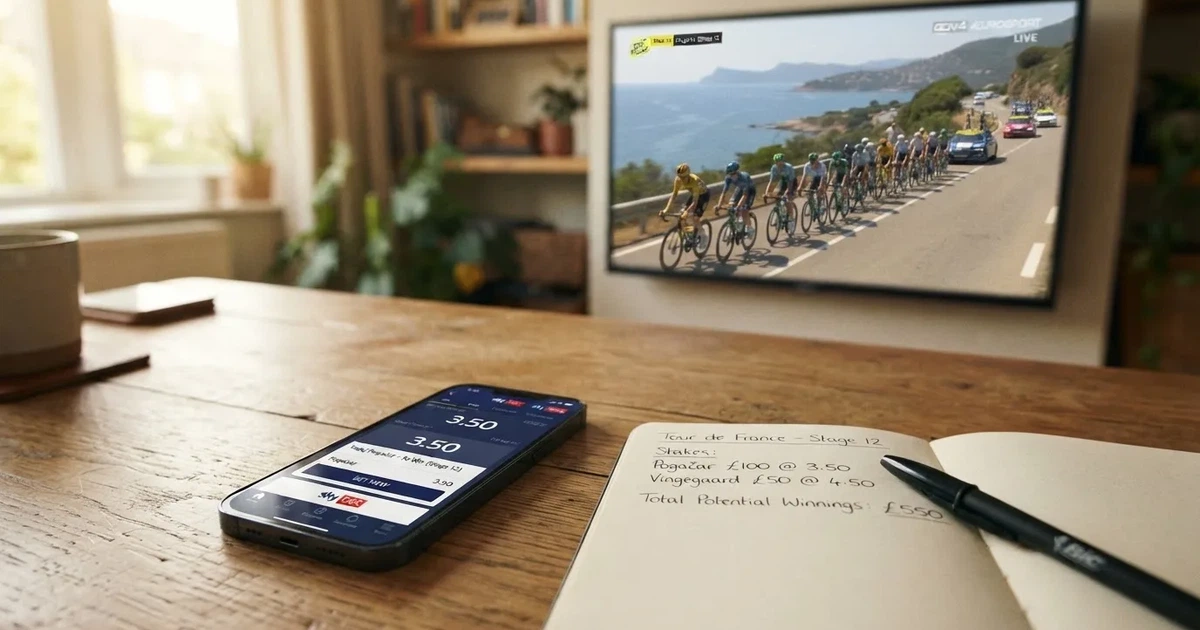
The market moves. The picture in front of you was true on October 30, 2026 and was checked against each operator’s own published terms and the Commission’s public register.
What “cycling odds” actually means at a bookmaker
The price is two things at once
Every decimal price on a cycling market answers two questions in one number. The first is what a winning bet pays back — stake multiplied by odds, with profit being stake multiplied by (odds minus one). The second is how confident the bookmaker is that the pick loses, because the price sits inside a wider market whose outcomes are quoted to sum to more than 100% and whose surplus is the bookmaker’s margin. A 2.10 on Tadej Pogačar to win a Grand Tour stage is both the answer to “what do I win if he wins?” and a quiet admission of where the firm thinks the field sits. The same price on the same rider, ten minutes later, after a crash in the peloton, is a different pair of answers: the payout formula is unchanged, but the market inside it has shifted.
Decimal odds are the standard at every British-licensed site. A 5/1 shot (five units of profit per unit staked) is 6.00 in decimals; 11/4 is 3.75; evens is 2.00. The conversion is the simple one — fractional odds plus one — and the conversion alone explains why a price the firm calls “5/1” on the betting slip never pays 6.00 for every pound you stake. It pays 6.00 pounds for every pound you stake when you win: five pound profit, one pound stake returned. That distinction is the one the brochure blurs and the slip clarifies.
The margin is the quiet cost
The margin sits below the price column like sediment below a river. Take a market with two credible outcomes — for illustration, an even-money match-up priced 1.90 / 1.90, the kind of line a bookmaker might write on a head-to-head in a one-day classic where one rider is a slight favourite. Add the implied probabilities the two prices represent: 1 divided by 1.90, twice. That gives about 52.6% and 52.6%, summing to roughly 105.3%. The 5.3% above 100% is the margin. The two prices look fair because the favourite and the outsider look balanced; the math says the firm is keeping about 5.3 pence out of every pound staked on this market, every time the race is run, regardless of who wins.
That figure varies across the markets a cycling book offers. A two-way outright has a thinner book than a four-way stage podium market; a market with a clear favourite carries more margin than a wide-open field. The point is not to memorise the number — it is to know that the price column already includes the firm’s cut, and that the cut changes shape of the book. A bettor who finds two bookmakers quoting 3.40 and 3.60 on the same rider is not being told two different stories about the rider’s chance. They are being told two different stories about how much each firm expects to keep.
The result on this page
For the illustrative 1.90 / 1.90 two-way market the calculation above is the worked number. With two outcomes at the same price, the implied probabilities sum to roughly 105.26%, so the payout share is around 94.74% and the bookmaker’s margin sits at roughly 5.26%. The figure is a band rather than a single number because no two markets on the same race sit at exactly the same margin: the headline price will be in this neighbourhood, with the wider stage and outrunner markets a touch higher. The conclusion is the practical one. Cycling markets at GB-licensed bookmakers typically keep somewhere between 4% and 8% of every pound staked across the major markets, with the lower end on outrights and the upper end on exotic markets such as head-to-heads between two named riders in mid-race. A reader who treats 5% as a useful middle is rarely wrong.
The legal frame: what a Gambling Commission licence actually buys you
Who licenses, and why it matters
The Gambling Commission licenses the commercial market in Great Britain under the Gambling Act 2005, with remote betting covered since the Gambling (Licensing and Advertising) Act 2014. An operator whose site is used in Great Britain needs a Commission licence wherever it is based — Gibraltar, Malta, Curaçao, the Isle of Man — and a non-GB licence does not substitute. The Commission’s public register is the test of who holds one. Any of the brands covered further down this page can be checked there, by name, by domain or by account number, against the categories on the register and the holder named for each. The register is the only honest source of that information; the marketing line “licensed and regulated” is the language of the trade.
Great Britain means England, Scotland and Wales. Northern Ireland sits under its own older law, and a GB licence does not extend there. The brands reviewed below are GB-licensed and intended for GB customers; a reader in Belfast is reading a market guide, not a list of brands they can use.
The licence categories that show up on a cycling site
A GB remote betting licence is not one licence but several, and the categories on the register reflect what the firm is allowed to offer. Remote general betting standard (real events) is the licence under which a firm takes bets on actual races — the Tour de France, the Giro, the classics, the World Championships. Remote general betting standard (virtual events) covers computer-generated races, which the regulator treats as a separate product. Remote betting intermediary is the exchange licence, used by Matchbook and anyone else who runs a back-and-lay book. Remote pool betting covers pari-mutuel products such as horse racing pools; it is not the licence a cycling book needs, but the same operator may hold it for racing.
A reader comparing two cycling bookmakers is comparing two holders of the real-events licence, and the categories on the register tell them whether the firm is also licensed for exchanges, virtual events or pool betting — which matters if the reader wants to lay a rider off as well as back them.
The rules the licence imposes on the operator
Three rules shape what a GB-licensed cycling book looks like to the customer. Identity is verified before the first deposit, including for a free bet or bonus — name, address and date of birth checked against public records, with the deeper source-of-funds questions arriving at higher spend. Credit cards are banned for gambling in Great Britain; debit cards, bank transfers and most e-wallets are not. Gambling advertisements in non-broadcast media run under the CAP Code, on broadcast media under the BCAP Code, both enforced by the ASA, with the social-responsibility rules sitting alongside the Commission’s LCCP conditions.
A bonus at a GB-licensed bookmaker sits under the wagering cap that came in on the same date: wagering requirements are limited to 10x the bonus base, so a £10 bonus can ask for at most £100 of qualifying bets. Mixed-product promotions — an offer that requires betting on football to get free spins, for instance — are banned. Free bets with no wagering condition are outside the cap; the rule applies to bonuses and to free bets that carry turnover.
The 2026 changes worth knowing
The promotion rules above took force on 19 January 2026 and are now the working ceiling on a GB bookmaker’s welcome offer. A second set of changes — the phased deposit-limit requirements under RTS 12 — has had its first phase in place since 31 October 2025, with the second phase pushed to 30 September 2026; whether that second phase is live at the moment of reading should be checked on the operator’s own safer-gambling page. The financial vulnerability check is in force from 28 February 2025 for customers whose net deposits exceed £150 over a rolling 30 days; it is a public-record check, not an income or credit check, and the “affordability checks” some headlines describe remain announced and staged, with no start date. A reader on this page will not normally meet these mid-bet; they will see them at deposit or withdrawal.
Tax on winnings is not the bettor’s concern. General Betting Duty is the operator’s tax on gross profits at 15%, rising to a 25% remote rate from 1 April 2027, while bets on UK horse racing, pool betting and in-person bets stay at 15%; spread betting is on its own rates. Whether operators pass it on to the price is not established, and a reader who pays no tax on a winning cycling bet is in the ordinary position, not a privileged one.
Staying in control of the bet
A cycling season runs from January classics through the spring classics, the Grand Tours, the late-summer stage races and the autumn Worlds, finishing in October. A reader with the discipline to bet across that calendar needs the discipline to set the calendar’s other side: a stake limit that the reader chooses, not the operator, and a self-exclusion route that holds across every brand the reader might use. The two are different mechanisms and the second matters more than the first when the first is not being set.
GAMSTOP is the national multi-operator self-exclusion scheme, free to use, and a mandatory condition of every GB remote betting licence. A registration excludes the customer from every online brand on the scheme for six months, one year, five years, or five years with auto-renewal. After the minimum period the exclusion stays in place for a further seven years unless the customer asks GAMSTOP to remove it. It does not cover betting shops, which use a separate service. It does cover the apps and sites of every brand reviewed below. The route is one form, one match, every operator.
A stake limit and a deposit limit are not the same thing. The reader chooses both. The Commission requires every operator to offer a deposit limit on a fixed time frame — the customer sets a gross ceiling on the amount that can be deposited into the account over a week or a month, and the operator enforces it. The customer may also set a stake limit, often at the betting-slip level; the two work in series, and a deposit limit is the broader one because it catches any payment route the account has. There is no state-set ceiling on either; the regulator’s role is to ensure the operator offers the tool, not to set the number.
The financial vulnerability check is not an affordability check. It looks at public records — bankruptcies, county court judgments, debt-management arrangements — and triggers at net deposits above £150 in a rolling 30 days. It will arrive at a heavier bettor; a casual stage-reader rarely sees it. Where it triggers, the operator may ask the customer to confirm their financial position, but the framework is light-touch and not the credit-reference check the headlines describe.
When any of these tools is not enough, the help lines do not replace them. GamCare runs the National Gambling Helpline. GambleAware funds treatment and education. The NHS runs gambling clinics. Gamblers Anonymous runs meetings. The four are not the same service, and a customer who needs one of them usually needs more than one. The customer services page of every GB-licensed operator links these by name.
The shape of a cycling betting market
The road racing calendar runs from January’s Tour Down Under to October’s Il Lombardia, with the spring classics, the Grand Tours and the World Championships at the centre. Outrights, stage winners, head-to-heads, podium finishes, classification markets, combi bets — the menu a bookmaker offers depends on whether the race is a one-day classic, a stage race or a championship.
Outrights
An outright is the bet on who wins the race. The Giro d’Italia, the Tour de France and the Vuelta a España are the three Grand Tours, each running between fifteen and twenty-three days under the UCI’s rule, with two rest days and a leader’s jersey — pink in the Giro, yellow in the Tour, red in the Vuelta. The 2026 Tour de France ran from 4 to 26 July 2026, starting with a team time trial in Barcelona and finishing on the Champs-Élysées, over 21 stages, 3,245 km and 23 teams, with Tadej Pogačar taking his fifth Tour win.
Outright markets open months ahead of the race, with the price reflecting the bookmaker’s view of the field months before the start list is final. A price in February on a July race is not the price in July; the field thins, the form finds its shape, the price moves. A reader who backs a name in February at a longer price has bought time as much as a tip.
Stage markets
A Grand Tour stage market is a separate market per stage, often with head-to-heads, group winner markets, podium markets and combi bets layered on top. The bookmaker builds a margin on each of them; the stage winner market and the top-three market do not share a margin even when they cover the same stage. A reader laying a small stake on a stage favourite and a larger stake on the same rider to finish in the top three is paying two margins and staking twice.
In-running on a stage is offered at most GB-licensed books, with the markets settling in real time as the breakaway forms, the peloton reels them back, and the sprint or summit finish resolves. The mechanics are the operator’s; the controls are theirs as well — limits, suspensions, cash-out offers that may not be honoured if the market is suspended — and a reader betting in-running on a stage is betting inside the operator’s framework, not their own.
Head-to-head and classification markets
A head-to-head names two riders and asks which of them finishes higher in the stage or the race; the price is built like a tennis match, two prices, one market, the margin spread across the pair. Mountain classification, points classification and young rider classification are running markets inside a Grand Tour, with the leader’s jersey changing as the race moves, and a bettor can back a classification winner at the start or layer positions during the race.
Combination bets
A combination bet — an acca, an each-way, a bet builder across several markets — multiplies the odds of the legs into one price. The payout on a winning acca is the stake multiplied by the combined odds; the implied margin is the compounded margin of each leg. Two legs at 3% margin does not give a 6% margin on the combination; it gives a higher margin, because the bookmaker’s edge compounds on the multiplier. A two-leg acca on two stages of the same Grand Tour is paying two margins on one ticket, and the price reflects that.
An each-way bet on a stage winner is two bets of equal stake — the win half and the place half — with the place terms set by the operator and varying by race. A bookmaker’s place terms are a market decision; a reader who wants to know whether a place is paying a quarter or a fifth of the win price reads the betting slip before placing the bet.
The same markets, different menus
Not every bookmaker carries every market. Matchbook, as a betting exchange, lets customers back and lay, with prices set by users rather than the firm. Spreadex combines fixed-odds and spread betting, and the spread side lets a reader take a position on a rider’s finishing position rather than name the winner. DAZN Bet and Hollywoodbets carry mainstream markets; smaller GB-licensed books may carry fewer markets per race and rely on outrights and stage winners. The reader’s market is in the menu, and a menu that does not carry the race the reader wants is a bookmaker for another race.
The ten reviewed bookmakers
Each brand below holds a Gambling Commission remote licence and takes bets on cycling. The licence details come from the Commission’s public register and the operator’s own terms. The review covers what the operator offers for cycling, the licence, and what the brand is for. The order is the order of the Commission’s register entries, not a ranking.
| Brand | Gambling Commission licence (account) and holder | Operator terms on cycling |
|---|---|---|
| DragonBet | 64908 (DragonBet Ltd) | Features Grand Tour stage and outright markets |
| Fafabet | 57385 (Taichi Tech Limited) | Grand Tour outrights and stage markets |
| Betboro | 44181 (Webmedia Development N.V.) | Major cycling races included |
| Matchbook | 39504 (Triplebet Limited) | Exchange model: back and lay options |
| Spreadex | 8835 (Spreadex Limited) | Fixed-odds and spread betting on cycling |
| DAZN Bet | 48756 (DZBT Limited) | Major races included in wider menu |
| Bet Ahoy | 100094 (Bet Ahoy Ltd) | Major races included in wider menu |
| London Bet | 66162 (Thistle Bet Limited) | Major races usually included |
| 10bet | 43173 (Blue Star Planet Limited) | Cash out and bet builder on major races |
| Hollywoodbets | 53028 (Hollywoodbets International UK Limited) | Major races included in wider menu |
DragonBet
DragonBet’s app is published by DragonBet Ltd and features Welsh football and rugby markets, racing, American football, in-play betting and bet builder markets. The licence is Gambling Commission account 64908, remote general betting standard (real events), with the site on the register under that holder. Cycling sits on a menu that is wider than the Welsh football focus suggests, with stage and outright markets on the Grand Tours; a reader wanting a GB-licensed book that carries both national and European cycling will find the menu covers the major races without crowding the slip with novelties.
For the bettor who follows the spring classics and the Grand Tours on a Welsh-focused book. Cycling is on the slip but is not the headline.
Fafabet
Fafabet pays Best Odds Guaranteed on UK and Irish horse racing win and each-way bets from 9am on race days, with the bigger of the original price and the starting price paid if the SP is bigger. Cycling is not the headline, but the brand carries Grand Tour outrights and stage markets; the BOG mechanic does not extend to cycling, where the price is the price.
The licence is Gambling Commission account 57385, remote general betting standard (real events), held by Taichi Tech Limited. For the bettor who wants a GB-licensed book that pays out at SP on racing and covers the major cycling races as part of a wider menu.
Betboro
Betboro’s sports welcome offer is a 100% matched free bet of up to £25 on the first qualifying wager, requiring a debit-card deposit of at least £10 and a first bet of £5 to £25 with at least three selections each at 3/5 (1.60) or higher. The licence is Gambling Commission account 44181, remote general betting standard (real events), held by Webmedia Development N.V. Cycling markets cover the major races, with the welcome offer framed for a multi-leg acca rather than a single.
For the bettor laying a small acca on a Grand Tour stage. The free-bet stake is not paid back on a win, and the qualifying bet must clear three legs at minimum price 1.60.
Matchbook
Matchbook is a betting exchange where customers bet against other users, with Bet Builder, multiples, in-play betting and live streaming of horse racing and greyhounds. The licence is Gambling Commission account 39504, with both remote general betting standard (real events) and remote betting intermediary categories on the register, held by Triplebet Limited. The exchange model means a reader can lay a rider as well as back them, and the prices on the platform are set by users rather than the firm.
For the bettor who wants to lay a favourite off rather than just back one. The margin on an exchange is set by the gap between back and lay prices, not by a single bookmaker’s spread.
Spreadex
Spreadex is regulated by the FCA for spread betting and by the Gambling Commission for fixed-odds betting, with both fixed-odds and spread betting combined in one app, with one-click, auto and partial cash out, Bet Builder across fixed odds or spreads, and live streaming of UK and Irish horse racing, greyhounds, tennis, NFL and selected football. The licence is Gambling Commission account 8835, remote general betting standard (real events), held by Spreadex Limited. The spread side lets a reader take a position on a rider’s finishing position rather than name the winner; the fixed-odds side offers the standard menu.
For the bettor who wants spread betting on a stage result as well as fixed odds. Spread betting losses can exceed the deposit, and the FCA regulation on the financial side is a different regime from the Commission’s general betting rules.
DAZN Bet
DAZN Bet deposits start at £5 by debit card, Apple Pay, Paysafecard, Trustly and Skrill, and at £20 by PayPal, with no processing fees. The licence is Gambling Commission account 48756, remote general betting standard (real events), held by DZBT Limited. Cycling coverage on the major races sits alongside a wider menu; the deposit floor varies by method, with PayPal the higher of the two thresholds.
For the bettor who wants a GB-licensed book with a £5 deposit floor on the standard methods. PayPal users start at £20.
Bet Ahoy
Bet Ahoy’s welcome offer is “Bet £10 & Get £10 in Free Bets”, made up of a £5 sports bet and a £5 acca. The licence is Gambling Commission account 100094, remote general betting standard (real events), held by Bet Ahoy Ltd. Cycling markets on the major races sit inside a wider menu; the welcome offer splits the free-bet total across a single and an acca, so the qualifying bet must clear both halves within the operator’s terms.
For the bettor who wants a £10 free-bet welcome split across two bet types. The split is structural, not optional, and the terms of each half are read separately.
London Bet
London Bet’s app combines sports betting — football, tennis, horse racing, greyhounds, darts, golf, cricket, NFL, NBA, MLB, snooker — with Pragmatic Play casino slots and live in-play betting. The licence is Gambling Commission account 66162, remote general betting standard (real events), held by Thistle Bet Limited. Cycling sits inside a wider menu of mainstream sports; the in-play offer covers selected events, with the major races usually included.
For the bettor who wants a GB-licensed book with a wide mainstream menu and Pragmatic casino slots alongside the sportsbook.
10bet
10bet’s sportsbook covers football, tennis and horse racing, with Cash out, Bet Builder and Live Streaming. The licence is Gambling Commission account 43173, remote general betting standard (real events), held by Blue Star Planet Limited. Cycling is on the menu for the major races, with cash out and bet builder available; live streaming covers selected events rather than every race.
For the bettor who wants cash out and bet builder on a Grand Tour stage. Live streaming is on selected events, and the reader checks the schedule.
Hollywoodbets
Hollywoodbets’ sports welcome offer pays the stake back as a free bet of up to £30 on the first qualifying losing accumulator — a stake of £10 or more, three or more legs, odds of 4/1 (5.00) or greater, settled within seven days; one free bet per customer. The licence is Gambling Commission account 53028, remote general betting standard (real events), held by Hollywoodbets International UK Limited. The offer refunds the stake on a losing acca, with the refund as a free bet rather than cash, and the time and odds constraints narrow the qualifying window.
For the bettor who wants a stake-back on a losing multi-leg acca. The free bet is the refund, not cash, and the seven-day settlement window matters when the calendar is light.
How the licence check actually works
A reader who wants to verify a brand’s licence goes to the Commission’s public register, searches by business name, trading name, domain or account number, and reads the entry. The categories on the register tell them what the firm is licensed for; the holder named on the entry is the legal entity. A brand with a domain on the register and a remote general betting standard (real events) category is licensed to take bets on cycling at the named site. A brand whose domain does not resolve on the register is not licensed to take bets from Great Britain, whatever the marketing line on its homepage says.
The check takes a minute. The result is not a recommendation and not a quality grade; it is a statement of fact about whether the firm holds the licence it claims.
Frequently asked questions
How is a cycling bet’s return worked out from the stake and the odds?
A winning bet pays back the stake multiplied by the odds. A £10 stake at 6.00 pays £60, made up of £10 stake returned and £50 profit. A combination bet multiplies the odds of the legs together first, so two legs at 3.00 each become a combined price of 9.00; the same £10 stake pays £90 if both legs win, £80 of which is profit. The formula is unchanged across single, double, treble and longer accas.
What is the bookmaker’s margin, and how can it be seen in the odds?
The margin is the cut the bookmaker keeps out of every pound staked on a market. It is read off the implied probabilities the prices imply — for a two-way market with outcomes at 1.90 each, the two implied probabilities sum to about 105.3%, the 5.3% above 100% being the margin. The same approach works for any market: add the implied probabilities across the outcomes, and the surplus over 100% is the firm’s take.
How do fractional odds such as 5/1 convert to decimal odds such as 6.00?
A fractional price a/b in decimal terms is (a divided by b) + 1. 5/1 becomes 5 divided by 1 plus 1, or 6.00. 11/4 becomes 11 divided by 4 plus 1, or 3.75. Evens, written 1/1, becomes 1 divided by 1 plus 1, or 2.00. The “+1” is the stake being returned; the fractional form is profit per unit stake, the decimal form is total return per unit stake.
Can a reader check whether a bookmaker holds a Gambling Commission licence?
Yes, through the Commission’s public register. The register can be searched by business name, trading name, domain or account number. A reading of the entry shows the holder, the categories the firm is licensed for, and the site the licence covers. A match on the register is the test of whether the firm holds the licence it claims.
What does a GB licence give a cycling bettor that an offshore site does not?
Identity is verified before the first deposit, including for a free bet or bonus. Credit cards cannot be used. Wagering requirements on bonuses are capped at 10x. GAMSTOP self-exclusion covers every GB-licensed brand. The Commission’s complaints route and an approved dispute-resolution service are available. Mixed-product promotions are banned. None of these protections are available at an unlicensed site, and the bettor’s funds are at the firm’s discretion if the firm withholds them.
Combat & motorsport – Inplayguide.com
Content created by the «Inplayguide.com» team
