
Gaelic football betting odds in 2026: how prices are set, where the margin hides, and what to do with it
 Available in US
Odds on a Gaelic football match are not a forecast. They are a price, and the price carries a cost the marketing line never names. A 1.90 / 1.90 line on a championship match does not say the two teams are equal; it says the bookmaker is taking roughly 5 % of every pound that settles on the match. The page below is about reading that number, finding it on a licensed bookmaker’s site and deciding what it is worth to a real betting account.

The current register, wagering rules and operator offers are taken as they stood on October 30, 2026 and checked against the Gambling Commission’s public register of remote betting licences.
The shape of the game and why it matters to a price
Gaelic football is played on a grass pitch 130 to 145 metres long and 80 to 90 metres wide by teams of fifteen, with fifteen named substitutes of whom six may take the field during a senior inter-county match. Senior matches run seventy minutes, two halves of thirty-five; most other adult grades run sixty. The team with the higher score after the seventy minutes wins, and scores come in two shapes: a goal, struck under the crossbar into the net, is worth three points, and a point, struck over the crossbar, is worth one. Since the 2025 rule changes a shot from outside the new forty-metre arc is worth two points, which is why a one-point lead at the break is a different proposition in a high-arc contest than in a tight defence. A scoreline of 1-20 to 1-17 reads as twenty-three to twenty, the same total a tipster would call close, but the goal count is what shapes the half-time market and the handicap.
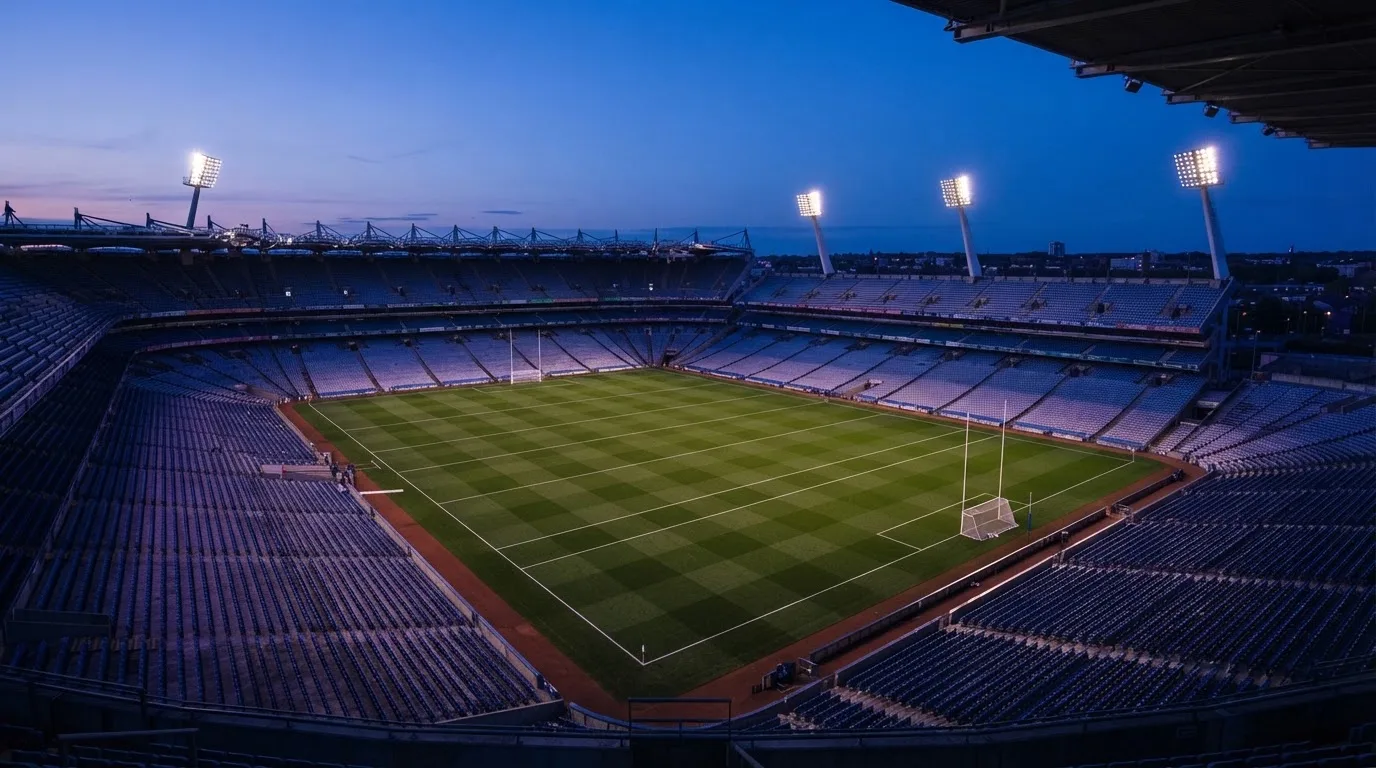
The game is run by the Gaelic Athletic Association, the GAA, and the championship that draws the deepest price discovery is the All-Ireland Senior Football Championship, whose final goes ahead each year at Croke Park, Dublin. Kerry hold the most All-Ireland senior titles, with thirty-nine. The most recent final on record was played on 26 July 2026 at Croke Park, with Mayo beating Kerry by 1-20 to 1-17 for their fourth title. That fixture, and the provincial rounds that lead to it, is where a UK-licensed bookmaker is most likely to post a deep enough market to compare prices from one operator to the next.
What the game is and how it is scored drives what a bookmaker can price. A 1X2 line (home win, draw, away win) on a sport that ends in a draw is a different calculation from a match in football or basketball. A handicap of three points is large by Gaelic football standards; a handicap of seven is enormous. A total goals-and-points line, the equivalent of a match goals over/under, is settled on the combined score, and a price on “first goalscorer” runs in a sport where a single goal is a decisive event.
Where Gaelic football sits in the British betting market
In Great Britain there is no statutory list of permitted sports or markets. A bookmaker serving customers in Great Britain needs a Gambling Commission licence wherever it is based, and the Commission’s public register is the whole test of who holds one. The licence category most online sports bookmakers run under is remote general betting standard (real events); betting exchanges, spread-betting firms and pool operators sit under different categories. Several brands can run under one licence holder, which is why Ladbrokes, Paddy Power and Betfair do not need separate licences: the operator, not the trading name, is what the register names.

The market for Gaelic football inside that framework is narrow. The All-Ireland championship and the National League are the fixtures most bookmakers price, the provincial championships sit underneath them, and club fixtures are a thin line at best. A bettor looking for a price on a club match will find fewer markets, larger spreads and longer suspensions between price updates. The decision is rarely which site has the longest list: it is which site has the price and the right market at the time the bettor wants to place.
What a GB-licensed bookmaker is required to offer
A licensed operator’s safer-gambling duty is not an optional promise. The customer can set a deposit limit, take a time-out, self-exclude through GAMSTOP for six months, one year, five years, or five years with auto-renewal, and the exclusion stays in force for a further seven years after the minimum period unless they ask GAMSTOP to remove it. Identity is checked before the first deposit, on the date of birth, name and address, with a free bet or bonus included. Credit cards have been banned for gambling in Great Britain since 14 April 2020, and that ban covers a credit card funding an e-wallet that pays the bookmaker. A financial vulnerability check has been in force since 30 August 2024 and is triggered when deposits minus withdrawals exceed £150 in a rolling thirty days. Bonuses carry a wagering cap, ten times the bonus value, and a promotion that requires gambling across product types, betting plus casino, plus bingo or lottery, is banned.
These are the conditions a GB-licensed bookmaker must meet. The rule of thumb is the licence itself, not the marketing: a brand that is on the Commission’s register is bound by the rule, and a brand that is not is not.
Reading a price and what the margin costs
The bookmaker’s margin is the slice of every pound staked that the operator keeps, on average, across a market. It is built into every price, and a bettor cannot escape it, only choose a market where it is small.
Take a fictional two-way market priced at 1.90 against 1.90. The implied probabilities of those two prices are 1 ÷ 1.90 and 1 ÷ 1.90, which work out to 52.63 % and 52.63 %. The two probabilities sum to 105.26 %, and the gap between that sum and 100 % is the margin, 5.26 %, or roughly a 5p bookmaker’s take on every pound bet on the market. The punter’s payout share, the share of the stake that comes back across all outcomes averaged together, is 100 % minus the margin, 94.74 %. A market priced at 1.85 against 1.85 carries a heavier margin, 8.11 %, because the two implied probabilities sum to 108.11 %; a market priced at 1.95 against 1.95 carries a lighter one, 2.56 %.
That margin is the cost of placing a bet, before the bettor has any view on the match. A 5.26 % margin on a single bet is the same as losing 5.26p on every pound staked, on average, over a large number of bets at the same price. Two bets of £10 at a 5.26 % margin cost £1.05 across the long run, the same as one bet of £20 at the same price, and the same as ten bets of £2 at the same price. The arithmetic is the same whether the bettor thinks the price is value or not; the price already contains the take.
A two-way market is a simplification, because most Gaelic football markets are three-way: home win, draw, away win. The same calculation works on three prices. A line of 2.20 / 3.40 / 3.40 implies 45.45 % + 29.41 % + 29.41 %, a sum of 104.27 % and a margin of 4.1 %. A line of 2.00 / 3.50 / 3.75 implies 50.00 % + 28.57 % + 26.67 %, a sum of 105.24 % and a margin of 5.0 %. The margin is a property of the whole market, not of any single price, and the price the bettor takes is on top of it.
The practical read: where a bookmaker posts a market, the bettor’s first job is to add the implied probabilities. If they sum to 102 % the margin is 2 %, which is on the low end for an in-season football market. If they sum to 108 % the margin is 8 %, which is high. A 1 % difference in margin is, over a year of betting, a real sum of money.
What a winning bet pays back
A single bet at decimal odds works in a fixed way. A stake of £10 at odds of 2.50 returns £25, the stake of £10 plus a profit of £15. A stake of £10 at odds of 5.00 returns £50, the stake plus a profit of £40. The decimal odds carry the stake in the return; the profit is the stake times the odds minus one. The bookmaker’s terms call this the return, meaning stake plus winnings, and the profit is the return minus the stake.
A combination bet, an accumulator or “acca”, works the same way on its legs. A £10 accumulator on three legs at 1.80, 2.20 and 2.50 has combined odds of 1.80 × 2.20 × 2.50, which is 9.90. A winning accumulator returns £99, the stake of £10 times 9.90. A losing leg loses the whole stake; the bet does not pay out the legs that won. The combination is what a bettor pays the bookmaker for: each leg carries its own margin, and a three-leg accumulator at a 5 % margin on each leg has an effective margin of roughly 14.3 %, not 5 %.
A each-way bet is two bets of equal stake. A £10 each-way at odds of 8.00 is two £5 bets: a £5 win bet at 8.00 and a £5 place bet at the place terms, which the bookmaker sets by race and by sport. A winning each-way bet pays the win leg in full and the place leg at the place fraction. In Gaelic football each-way betting is rare; the each-way market is more common on horse racing, where the place terms are explicit. On a sport without a published place fraction an each-way bet is a poor choice, and the bettor should check the terms before placing.
Bonus offers, free bets and the wagering that goes with them
Gaelic football betting offers, in the form of a welcome package, a price boost on a championship match or an acca insurance on a losing leg, are how a bookmaker draws a new account in. The marketing line rarely states the wagering requirement; the terms do. Two rules, in force since 19 January 2026, govern the way licensed UK bookmakers can structure a promotion: the wagering requirement is capped at ten times the bonus value, and a promotion that mixes product types, betting plus casino, plus bingo or lottery, is banned.
A wagering requirement of ten times the bonus is a real figure. A £10 bonus at ten times means £100 of qualifying bets before the bonus, and any winnings from it, can be withdrawn. Bets at a minimum price count, and a minimum price of 1.50 (1/2) on football is a common choice. A bettor who places one hundred £1 singles at 1.50 to clear the bonus has turned £10 of bonus money into an expected loss of about £5.26 on a 5.26 % margin, before the bonus clears. The bonus, in that example, is worth about £4.74 against an expected £5.26 cost. A price boost on a single match, by contrast, has no wagering if the bookmaker structures it as a price boost, and a free bet whose stake is not returned has a value that depends on the price at which the bettor uses it. The arithmetic is a property of the offer, not the sport.
A free bet is not a cash bonus. A free bet of £10 at odds of 3.00 returns £20 in profit, because the £10 stake is not paid back with a win, and the value of the free bet is a function of the odds. A free bet at long odds is worth more than the same free bet at short odds. The bookmaker’s terms should be checked for a cap on free-bet winnings, a minimum odds rule, a deadline and a list of eligible markets. A “risk-free” bet that refunds a losing stake as a free bet is not a refund in money: the bettor is back to the wagering requirement of the free bet the bookmaker has substituted. The marketing language is not the offer.
Live betting, cash out and the in-play market on a Gaelic match
In-play betting on Gaelic football is a thin book, in the sense that a licensed UK bookmaker typically offers the 1X2 line, the next-goal market and a small set of totals at half time and during the second half. The bet builder or same-game multi, where a single bet combines markets from one match, is offered on the bigger fixtures and tends to be the most lucrative in-play product for the bettor who has a view. Cash out, the option to close a bet before the match ends, is offered on the larger bookmakers; the cash-out price is the bookmaker’s mid-market quote at the time, and the bettor should not expect to cash out at the theoretical mid every time, because the cash-out price carries the bookmaker’s margin as well.
The half-time market is where the Gaelic game has its sharpest in-play moves. A team six points ahead at the break is a heavy favourite; a team a goal ahead is a different proposition, and the line on a team to win from behind is sensitive to the next score. A bettor who watches the second half will see the bookmaker’s price move faster than the bettor can click, and the price on offer at any moment is the only price the bettor has.
The operator’s own house rules settle the in-play market. A bet placed on the next score is settled on the result at the time the score is registered; a bet placed on the half-time result is settled at the whistle. A bet placed on a player market is settled on the official GAA record of the player. A bet that is voided under the operator’s terms is settled at the stake; a bet on a player who does not start is settled as a loser unless the operator’s terms say otherwise. The terms are the contract, and the bettor who places an in-play bet without reading them has agreed to a contract they have not read.
Strategy, predictions and what a tip can and cannot say
A Gaelic football betting tip is a forecast, and a forecast is not a bet. The bookmaker’s price is the bet, and the difference between a forecast and a price is the margin. A tipster who calls the winner at 1.50 has, in the long run, called a market that the bookmaker has priced at a 33.33 % implied probability with an 8.11 % margin baked in. The bettor is paying the margin to follow the tip, and the tip does not change the arithmetic.
A bankroll, the sum the bettor has put aside for betting, is a budget. A unit, the standard stake as a fraction of the bankroll, is the bettor’s defence against a run of losers. A common rule is one unit per cent of the bankroll, a £500 bankroll as a £5 unit. A rule of one to two per cent is more conservative, a rule of five per cent is aggressive and is the kind of staking a punter will not sustain through a long losing run. The staking plan is the bettor’s choice; the bookmaker does not enforce it.
The forecast is the bettor’s work: team news, recent form, head-to-head, the venue, the weather. A bookmaker’s price already reflects the public view, and the bettor who has information the bookmaker has not priced is the bettor who finds value. A bettor without that information is paying the margin to back the public view, and the public view is, on average, a losing position.
The bettor’s record is the only honest measure of whether the betting is working. A spreadsheet of stake, odds, return, profit and the closing price, the price the bookmaker posted at the off, will tell the bettor, over a season, whether the price they took was better than the closing price and whether the bets are profitable. A bettor who does not keep a record is betting blind, and a tipster’s newsletter does not change that.
Markets, bet types and the bookmaker’s terms
The market list on a Gaelic football match is shorter than the list on a Premier League fixture, and the bettor who wants a particular market should check the operator’s site before registering. The standard markets on a championship match are: match result (home win, draw, away win), handicap, total score, first team to score, first scoring play, half-time result, half-time/full-time, both teams to score, player to score and the bet builder or same-game multi. Spread betting is offered by a separate set of firms, and the bet on a spread is a bet on the margin of victory rather than the winner; the FCA regulates financial spread betting and the Gambling Commission regulates fixed-odds and other spread betting, and a spread-betting book can leave the customer with a loss that exceeds the deposit. That is the bookmaker’s own disclosure on the spread-betting product.
A handicap is a points adjustment to the underdog. A handicap of +3 on the away team means the away team starts the match, for the purposes of the bet, three points ahead. A handicap of -3 on the favourite means the favourite starts three points behind. The handicap is settled on the final score after the adjustment, and the price on each side is the bookmaker’s view of the implied probability with the margin added. A handicap of +6 on the away side is a long-priced underdog, and the price is the right one to take if the bettor’s view is that the match will be close.
A bet builder or same-game multi is a single bet that combines markets from one match. A bet builder on the home team to win, the total score to be under 21.5 and the home team’s first scorer to be a named forward is a single bet at a price that reflects the combined implied probability with a margin on each leg. The legs are linked, the price is calculated by the bookmaker, and the bet settles as one bet, with one stake. A losing leg voids nothing; the bet is a loser.
A price boost is a higher price on a single outcome, and a Super Boost or enhanced odds offer is the bookmaker’s way of drawing attention to a single match. A price boost is a bet at a higher price than the bookmaker’s standard line, and the boost is the value the bookmaker is offering. An accumulator insurance, a refund on a losing leg as a free bet, is a partial protection on a combination bet, and the refund is paid as a free bet whose value depends on the rules. Each boost is structured differently, and the bettor’s job is to read the small print.
Responsible gambling and the practical tools
A licensed bookmaker offers the same set of safer-gambling tools, and a bettor who has decided to bet on Gaelic football should set them before placing a bet. The first is a deposit limit, a ceiling on the gross amount the bettor will deposit in a day, a week or a month. The second is a time-out, a pause on the account for twenty-four hours, a week or a month. The third is self-exclusion, a six-month minimum, through GAMSTOP, which covers every licensed online bookmaker in Great Britain. The bettor can also set a stake limit on individual bets, a reality check that flashes on the screen at fixed intervals and a session-time reminder that closes the app at the end of a session.
A financial vulnerability check, in force since 30 August 2024, applies when the bettor’s deposits minus withdrawals exceed £150 in a rolling thirty days. The check is a public-record check, looking for county court judgments, bankruptcy orders and the like, and is not a credit check or an income check. A financial risk assessment, the more intrusive affordability check, has been announced in a staged plan, with no start date. The bettor who sets a deposit limit at the level they can afford does not have to take the vulnerability check in the first place.
The help lines are run by GamCare, the National Gambling Helpline, by GambleAware, which funds treatment and education, by the NHS, which runs gambling clinics, and by Gamblers Anonymous, the peer-support fellowship. A bettor who is concerned about their play can call the helpline, register with GAMSTOP and ask the bookmaker to close the account. The tools are a bookmaker’s safer-gambling duty, and a bettor who is not offered them is not dealing with a licensed bookmaker.
The licensed bookmakers reviewed
The ten bookmakers below are the brands the Commission’s public register lists against a remote general betting standard (real events) licence, in the order the operator set carries them. A licence on the register is the test, not a place in a ranking. The review covers the licence, the welcome offer in the operator’s own terms, the deposit and withdrawal method, the live-betting and bet-builder product and a verdict on who the brand suits.
Ladbrokes
Ladbrokes’ UK site runs under Gambling Commission account 54743. The mobile app, published by Entain Operations Limited, is rated 4.66 from 101,255 ratings in the GB App Store. The bookmaker covers horse racing, football, boxing, rugby, tennis, golf, darts, snooker and Formula 1 at a market depth that few of the smaller brands match, and Gaelic football is priced for the All-Ireland championship and the National League.
The verdict: a bettor who wants a deep in-play book, a long racing product and the same brand across the shop and the app will find Ladbrokes fits the bill. A bettor looking for a thinner book and a more focused welcome offer will pay the size of the brand in the spread on some lines.
Paddy Power
Paddy Power’s UK site runs under Gambling Commission account 39439. The mobile app, published by Paddy Power PLC, covers football, horse racing, boxing, rugby, tennis, golf, darts, snooker and Formula 1, and the brand is known for its money-back specials, which refund a losing stake as a free bet on a named event.
The verdict: a bettor who likes the money-back specials, a deep football book and a long racing product will find Paddy Power a good fit. The specials carry the same wagering requirement as any free bet, and the bettor who reads the terms gets the value.
DAZN Bet
DAZN Bet’s UK site runs under Gambling Commission account 48756. The bookmaker’s published deposit methods are debit card, Apple Pay, Paysafecard, Trustly and Skrill at a £5 minimum and PayPal at a £20 minimum, with no processing fees. The site is built around live and in-play, and Gaelic football is priced for the bigger championship matches.
The verdict: a bettor who wants a low-deposit, in-play-focused book and a clean mobile app will find DAZN Bet a good fit. The book is narrower than the larger brands, and the bettor who wants a deep racing product should look elsewhere.
BetUK
BetUK’s UK site runs under Gambling Commission account 39198. The sports welcome offer is four £10 free bets (two football accumulators of four or more selections and two multiples of two or more) for new customers who deposit £10 or more and place a sports bet within seven days of registering, with a seven-day validity and an opt-in required.
The verdict: a bettor who wants a focused football welcome and a clean mobile app will find BetUK a good fit. The four free bets are limited to multiples, and a bettor who backs singles is not getting the full value.
Sporting Index
Sporting Index’s UK site runs under Gambling Commission account 27343. The bookmaker is one of the few that lets customers switch between fixed odds and spread betting, with in-play betting, a Bet Builder for football, auto cash-out and Multi-Markets. The spread-betting product carries a separate FCA registration for financial spread betting, and the bookmaker’s own disclosure is that spread-betting losses can exceed the deposit.
The verdict: a bettor who wants the spread-betting product on a Gaelic football match will not find many alternatives, and Sporting Index is the right brand for that. A bettor who wants a fixed-odds book alone is paying for the spread product, and the smaller fixed-odds book is the cost.
BoyleSports
BoyleSports’ UK site runs under Gambling Commission account 39469. The sports welcome offer is £20 in free bets for a £10 bet for UK players, with a separate offer of €30 in free bets for a €10 bet for Irish players. The Irish heritage is visible in the depth of GAA pricing, and Gaelic football is priced for the championship.
The verdict: a bettor who wants the deeper GAA pricing and a focused welcome offer will find BoyleSports a good fit. The brand is smaller than Ladbrokes or Paddy Power, and the bettor who wants a deep racing product or a deep in-play book should look elsewhere.
Lottoland
Lottoland’s UK app, published by EU Lotto Limited, runs under Gambling Commission account 38991. The app combines casino, lottery betting, sports betting and scratchcards, and the bookmaker’s own terms state that the licence covers customers in Great Britain. The sports book is a smaller part of the app, and Gaelic football is priced for the bigger championship matches.
The verdict: a bettor who wants a single app for casino, lottery and a small sports book will find Lottoland a good fit.
Octobet
Octobet’s UK site runs under Gambling Commission account 62545. The sportsbook welcome offer is 50 % back as a free bet up to £50, plus a £10 casino bonus for new customers. The bookmaker is one of the smaller brands, and Gaelic football is priced for the bigger championship matches.
The verdict: a bettor who wants a clean mobile app, a smaller welcome offer and a focused book will find Octobet a good fit. The welcome offer mixes sports and casino, and the £10 casino bonus is paid separately, with its own wagering.
Kwiff
Kwiff’s UK site runs under Gambling Commission account 44448, on a remote general betting standard (real events) licence held by Eaton Gate Gaming Limited. The brand describes itself as a trademark operated by Spryme Ltd, and the app carries a 17+ age rating in the GB App Store. The bookmaker’s distinctive feature is “supercharged” odds, in which the bookmaker randomly boosts the price on a bet after the bet is placed, and the bettor sees the new price on the bet slip.
The verdict: a bettor who wants the chance of a random price boost on a Gaelic football match will find Kwiff a good fit. The random boost is a marketing line, and the bettor who reads the terms knows the boost is at the bookmaker’s discretion and on selected markets.
Betboro
Betboro’s UK site runs under Gambling Commission account 44181, on a remote general betting standard (real events) licence held by Webmedia Development N.V. The sports welcome offer, in the operator’s own terms, is a 100 % matched free bet of up to £25 on the first qualifying wager, with a debit card deposit of at least £10, a first bet of £5 to £25, and at least three selections at 3/5 (1.60) or higher.
The verdict: a bettor who wants a 100 % matched welcome on a multiple will find Betboro a good fit. The three-leg minimum at 1.60 is a real constraint, and a bettor who backs singles is not getting the welcome.
A side-by-side at the licences and the terms
The table below carries the licence number and licence holder, from the Commission’s public register, against the published key term on the welcome offer. The licence is a constant across the brand; the term is the operator’s own. A dash in the table means the operator’s terms do not state a number for that point.
| Brand | Licence and holder | Key term in the operator’s own terms |
|---|---|---|
| Ladbrokes | 54743, LC International Limited | Deep football and racing book; price boosts and acca insurance on the bigger matches |
| Paddy Power | 39439, PPB Counterparty Services Limited | Money-back specials as a free bet on named events; deep football book |
| DAZN Bet | 48756, DZBT Limited | £5 minimum deposit on debit card, Apple Pay, Paysafecard, Trustly, Skrill; £20 on PayPal |
| BetUK | 39198, LeoVegas Gaming PLC | Four £10 free bets, two football accas of 4+ and two multiples of 2+, on a £10+ deposit and a sports bet within 7 days |
| Sporting Index | 27343, Sporting Index Limited | Switch between fixed odds and spread betting; Bet Builder for football, auto cash-out |
| BoyleSports | 39469, Boylesports Enterprise | £20 in free bets for a £10 bet for UK players; deeper GAA pricing |
| Lottoland | 38991, EU Lotto Limited | Casino, lottery, sports and scratchcards in one app; GB licence for sports |
| Octobet | 62545, Octopus Game Limited | 50 % back as a free bet up to £50, plus a £10 casino bonus |
| Kwiff | 44448, Eaton Gate Gaming Limited | Random “supercharged” odds on selected markets |
| Betboro | 44181, Webmedia Development N.V. | 100 % matched free bet up to £25, first bet £5 to £25, three legs at 1.60 or higher |
The licence line is the same on every bookmaker’s terms; the welcome offer is the point where the brands diverge, and the divergence is the bettor’s choice. A bettor looking for a deep book with a long racing product and a long list of price boosts is reading the column for Ladbrokes or Paddy Power. A bettor looking for a thin book with a focused welcome is reading the column for BetUK or Betboro. A bettor who wants the spread-betting product is reading the column for Sporting Index. The table does not tell the bettor which welcome is the best value, because the value is a function of the price the bettor takes and the wagering the bookmaker has set, and that arithmetic is the bettor’s own.
A short look at the bettor’s arithmetic on a single match
A 1X2 line on a championship match at 2.20 / 3.40 / 3.40 implies 45.45 % + 29.41 % + 29.41 %, a sum of 104.27 % and a margin of 4.1 %. The bettor’s payout share across the market is 95.9 %, and the bettor who places one bet at random on the match is paying 4.1p on the pound, on average, for the bet. A bettor who places ten bets of £5 each at the same market is paying £2.05 across the long run, before any view of the match.
A bettor who backs the home side at 2.20 with a £10 stake returns £22 on a win, a profit of £12, and loses the £10 stake on a draw or an away win. A bettor who backs the draw at 3.40 with a £10 stake returns £34 on a draw, a profit of £24, and loses the £10 stake on a home or away win. The bookmaker’s profit on the market, across the long run, is the 4.27 % margin on the total amount staked.
A bet builder on the same match, a single bet on the home team to win, the total score to be under 21.5 and the home team’s first scorer to be a named forward, is a single bet at a price the bookmaker has calculated. The bookmaker’s margin on a bet builder is the combined margin of the legs, and a three-leg bet builder on a 4.27 % market has an effective margin of 12.16 %, not 4.27 %. A bettor who backs a bet builder is paying the bookmaker for the convenience of a single bet, and the convenience is the cost.
The arithmetic is the same on any market. The bettor who has a view on the match and a price the bookmaker has not yet moved is the bettor who finds value. The bettor who does not is paying the margin to back the public view, and the public view is, on average, a losing position.
Reading the Championship calendar and the fixtures that move the price
The All-Ireland Senior Football Championship runs from the provincial championships in May to the final in July. The National League runs from February to April. The pre-season competitions run from December to January, and the club championship runs from October to February. The fixtures that move the price are the provincial finals, the All-Ireland quarter-finals and semi-finals, and the final itself. A bookmaker’s price on a Dublin-Kerry quarter-final will be tighter than the price on a first-round provincial match, because the bookmaker has more information and the bettor is more interested.
The bookmaker’s price on a match is posted in the days before, and the price moves as team news, weather and betting volume come in. The bettor who takes the price the night before the match is taking a price the bookmaker has had time to sharpen. The bettor who takes the price an hour before the off is taking a price the bookmaker has had less time on, and the price may be softer or sharper, depending on where the money has come in. A bettor who watches the price move and is willing to wait is the bettor who finds the best price, and the best price is the price the bettor is paid for their information.
The half-time and full-time markets are settled on the result at the whistle, and a bet placed on the half-time result is settled at the half-time whistle. A bet placed on the next score is settled on the next score registered. A bet placed on a player market is settled on the official GAA record. The terms are the contract, and the bettor who places a bet without reading the terms has agreed to a contract they have not read.
The bettor’s check on a bookmaker
A licensed bookmaker is a bookmaker on the Gambling Commission’s public register, and the register is searchable by business name, trading name, domain or account number. The check takes a minute: open the register, enter the brand’s name, and confirm that the account number on the register matches the brand the bettor is dealing with. The account number is the test, not the marketing, and the brand that is not on the register is not a licensed bookmaker for the purposes of Great Britain.
The register lists the licence holder, the trading names, the licence categories and the licence status. A licence can be suspended, surrendered or revoked, and the register is the only place that status is published. A bettor who places a bet on a brand whose licence has been suspended is not betting with a licensed bookmaker, and the protections that follow the licence, the safer-gambling tools, the GAMSTOP coverage, the 10x bonus cap, the dispute-resolution route, are not in place.
The bettor should also check the bookmaker’s terms on identity, deposits, withdrawals, wagering, in-play rules and customer service before placing a bet. The terms are the contract, and the bettor who has not read the terms is not in a position to judge the value of the offer. The bookmaker is in business to make a margin on the bet, and the bettor who has read the terms is in a position to judge the margin.
A note on the offshore option and the protections the bet loses
A bookmaker licensed outside Great Britain is not bound by the Gambling Commission’s rules, and a bettor who places a bet on an offshore site is not covered by the safer-gambling tools, the GAMSTOP coverage, the 10x bonus cap, the £150 vulnerability check, the dispute-resolution route, the British consumer redress or the General Betting Duty. The bookmaker may be licensed in its own jurisdiction, and that licence may be a real one, but it is not a Great Britain licence, and the protections a Great Britain licence brings are not in force.
The Commission’s enforcement is against the operator, not the customer. The customer who places a bet on an unlicensed site is not committing an offence under the Gambling Act 2005, and the bet is not, in the strict legal sense, illegal. The customer is losing the protections a GB licence brings, and the loss is real if the operator withholds funds, refuses a withdrawal or applies a term the bettor has not agreed to. The licensed and the unlicensed are not “the safe choice” by default; they are the choice with and the choice without the British protections, and the bettor’s decision is which set of risks to take.
A VPN is not a workaround. The bookmaker’s terms require the bettor to be in Great Britain, and a VPN that places the bettor’s connection in Great Britain is a deception the bookmaker is entitled to treat as a breach. The bettor who signs up with a false address, a false date of birth or a VPN is not in a position to claim the British protections, because the bettor has not met the conditions for them. The offshore option is an option to leave the British protections behind, and the bettor who chooses it is choosing to leave them behind.
The questions a bettor on Gaelic football should ask
A few questions sit underneath the marketing and the price, and the bettor who has answered them is in a position to judge the value of a bet.
What is the market the bettor is backing, and is the bettor’s view stronger than the bookmaker’s view? The bookmaker’s price is the bettor’s first piece of information, and the bettor who disagrees with the price is the bettor who has information the bookmaker has not priced.
What is the margin on the market, and is the bettor paying more for the bet than the bet is worth? A 4 % margin is a tighter book than an 8 % margin, and the bettor who has the choice will take the tighter book.
What is the wagering requirement on the welcome offer, and is the bonus worth the bets the bettor has to place? A bonus with a 10x wagering requirement is the legal cap, and a bonus with a higher wagering requirement is not lawful at a licensed bookmaker.
What is the deadline on the free bet, and is the bettor in a position to use it before the deadline? A free bet with a seven-day validity is a different value from a free bet with a thirty-day validity, and the bettor who cannot meet the deadline is not getting the value.
What is the bettor’s bankroll, and what is the unit the bettor is staking? A bankroll of £500 and a unit of £5 is one staking plan, and a bankroll of £500 and a unit of £25 is a different staking plan, and the second is the staking plan that will not survive a losing run.
The questions are not predictions, and the answers are not a tip. They are the work the bettor does before the bet, and the work is what separates the bettor who has a record of profitable betting from the bettor who has a record of paying the bookmaker’s margin.
Frequently asked questions about Gaelic football betting
How is a bet on Gaelic football placed?
A licensed UK bookmaker is opened, the Gaelic football match is found in the football or GAA section, the market is selected, the stake is entered and the bet is confirmed on the bet slip. The bookmaker settles the bet at the conclusion of the match, on the official GAA record, and the winnings are added to the account balance. A withdrawal is requested from the cashier, to a payment method the bookmaker accepts, and the funds are paid under the bookmaker’s stated time frame.
How is a bookmaker’s Gambling Commission licence checked?
The Commission’s public register is opened, the brand’s name, domain or account number is entered, and the licence status is read from the register. The licence holder, the licence categories and the licence status are all on the register, and a licence that has been suspended or revoked is flagged on the register. The account number on the register is the test, not the marketing, and the bettor who checks the register before registering is in a position to know whether the brand is licensed.
How is the return on a bet worked out from the stake and the odds?
The return is the stake multiplied by the decimal odds. A stake of £10 at odds of 2.50 returns £25, the stake of £10 plus a profit of £15. The profit is the stake multiplied by the odds minus one. A combination bet, an accumulator, multiplies the odds of the legs into a single price, and the return is the stake multiplied by the combined odds.
What is the bookmaker’s margin and how is it seen in the odds?
The margin is the share of every pound staked that the bookmaker keeps, on average, across the market. It is the sum of the implied probabilities of the prices minus 100 %. A two-way market priced at 1.90 against 1.90 has a 5.26 % margin. A three-way market priced at 2.20 / 3.40 / 3.40 has a 4.27 % margin. The margin is a property of the market, and the price the bettor takes is on top of it.
How do fractional odds such as 5/1 convert to decimal odds such as 6.00?
A fractional price of a/b converts to a decimal price of a divided by b plus 1. A fractional 5/1 is 5 ÷ 1 + 1, which is 6.00. A fractional 11/4 is 11 ÷ 4 + 1, which is 3.75. A fractional evens, written 1/1, is 1 ÷ 1 + 1, which is 2.00. The decimal odds carry the stake in the return, and the fractional odds do not.
What safer-gambling tools does a licensed bookmaker have to offer?
A licensed bookmaker offers a deposit limit, a time-out, a self-exclusion through GAMSTOP, a stake limit on individual bets, a reality check that flashes at fixed intervals, a session-time reminder and a link to GamCare, the National Gambling Helpline. The bookmaker is bound by the LCCP to offer these tools, and a bookmaker that does not offer them is not a licensed bookmaker. The bettor can set the tools before placing a bet, and the bettor who has set a deposit limit is not in a position to lose more than the limit.
Rugby, cricket & Gaelic – Inplayguide.com
Content created by the «Inplayguide.com» team
