
Football Betting Tips 2026
 Available in US
Anyone who has spent even a Saturday on a betting app knows the figure that arrives in the message next to a selection. Decimal 1.85. Fractional 5/6. A small green number, promising a payout, asking for a stake. The marketing layer wraps it in a tip. A tipster promises today’s winner, today’s over 2.5, today’s acca. This guide is about what a tip actually is, what one costs, and which of ten GB-licensed bookmakers to trust with the stake behind it. The promises stay out. The arithmetic stays in.

Current as of October 30, 2026 and verified against the Gambling Commission’s public register of remote operating licences.
The ten operators this page covers, ranked on what makes them worth a punt
The list below is a shortlist of the ten brands the rest of this page refers to throughout. Each holds a remote general betting licence under the Gambling Act 2005, each participates in GAMSTOP, and each is presented in the same fixed order — based on the breadth of football coverage, the transparency of the published terms and the value left in a price after the margin is stripped out. A licence number is not a quality award, and a place in the list is not a recommendation of where to bet. The table below the rankings shows the licence side by side with one thing the operator’s own terms page states about its offer, so a reader can see what the licence authorises alongside what the operator chooses to do with it.

[Image: An open notebook with a pencil and a stopwatch on a wooden table. Caption: The Laws of the Game of association football are maintained by the International Football Association Board (IFAB), which has done so since 1886.]
Betway — the longest-standing football bookmaker of the ten
Betway holds Gambling Commission account 39372, set up across remote general betting standard (real events), and runs under Betway Limited. Its new-customer offer is framed as £40 in free bet tokens, delivered as four £10 units, and those tokens land only after a first bet of at least £10 settles at minimum odds of 2.0. The seven-day expiry on each token matters: a free bet whose stake is not returned with a win and which expires inside a week is the cheapest kind of “free” on this page. Debit cards only on the qualifying deposit, so e-wallet readers drop out. The mobile app is the usual channel for the offer, and live in-play markets sit inside a clean tabs-and-fixtures layout. For a punter who already has a debit card handy and a week to clear four tokens, Betway is a steady £10-per-week free-bet headline. For anyone timing their first deposit, the seven-day timer is the single number to plan around.
BetUK — the LeoVegas-run site with a tight exclusions list
BetUK trades on account 39198, held by LeoVegas Gaming PLC. Its free-bet offers exclude virtual sports, esports, and non-UK/Irish horse racing, so the headline number on a banner never tells the full story — the exclusions page does. Minimum odds apply on both the qualifying and the free-bet leg, and a punter who spends their qualifying stake on an esports final gets nothing back. The football market is the strong suit, with a deep match schedule and an in-play tab for every televised league. For a customer whose betting lives inside English football and who reads exclusions before clicking “claim”, BetUK is honestly priced. For an esports or virtual-only punter, the same offer is a closed door.
10bet — a balanced three-sport bookmaker with a full live suite
10bet runs under Blue Star Planet Limited on account 43173, licensed for remote general betting standard (real events) and staking its name on football, tennis and horse racing as the three consistent verticals. Cash Out, Bet Builder and Live Streaming are present as named features in the product, which is rarer than marketing suggests: each exists on most apps, but the combination together is the differentiator. The football Bet Builder is a same-game multi builder — combinations from one match rather than across several fixtures — and a 10bet selection book can run a dozen markets on a single Premier League fixture. For a customer who wants one bookmaker to cover pre-match, in-play and stream on a Saturday, 10bet has the pieces. The specific odds and the margin on the chosen market is the next thing to check.
LiveScore Bet — a payment-method-led bookmaker
LiveScore Bet is operated by LiveScore Betting and Gaming (Gibraltar) Limited under account 56859, and the brand leans on its payment page as a sales pitch. Debit cards (Visa and Mastercard), Apple Pay, PayPal, Pay by Bank via Open Banking and Revolut Pay are all listed, which gives a reader one of the broadest choices on this page. The product sits on the LiveScore scores backbone, which means in-play fixtures can be toggled into a live scores overlay without leaving the bet slip — a small detail for a customer who values current scores over current odds. For a customer whose wallet is Revolut or Apple Pay, the choice of bookmaker narrows here fast. The football odds still need a margin check, as with every brand.
London Bet — a Thistle Bet Limited bookmaker with a casino wing
London Bet is published by Thistle Bet Limited under account 66162. The product pairs a sportsbook covering football, tennis, horse racing, greyhounds, darts, golf, cricket, NFL, NBA, MLB and snooker with a Pragmatic Play slot and live in-play vertical, so one app holds an entire evening’s entertainment. The 17+ App Store age rating is the gate, not an in-app check. For a customer who wants a single download to cover a football tip, an NBA tip-off and 200 slot spins afterwards, the breadth is the value. The football terms still need reading — the broader the product, the more places a stake can go wrong.
Kwiff — the “Supercharge” bookmaker where a price can move at the moment of stake
Kwiff is operated by Eaton Gate Gaming Limited under account 44448. The product’s headline feature is Supercharge, a random odd on a placed bet that can move from a sensible price to 20/1 (decimal 21.00) on a single, on a multiple, or on any sport. The mechanic is a stake-level surprise: a £10 bet at 5/2 becomes a £10 bet at 20/1 if Kwiff decides to boost it, and the rest of the bet stays exactly as placed. There is no skill to triggering it and no opt-in, which is the honest framing. For a punter who likes the lottery shape of a flutter that can suddenly pay more than the price quoted, Kwiff is the right app. For a price-sensitive punter who wants the odds they were promised and nothing else, the surprise is the cost.
William Hill — the high-street name and the home of “Best Odds Guaranteed”
William Hill trades on account 39225, with WHG (International) Limited as the licence holder, and is the established brand on this list. Best Odds Guaranteed is the long-running headline: on UK and Irish horse racing from 8 AM on the day of the race, the price a punter takes becomes the higher of the price at placement and the starting price, on both singles and multiples. Ante-post, tote and pari-mutuel bets are outside the rule. For a horse-racing customer, that rule alone is a reason to keep the account open. For a football-only punter, the football margins and the structure of the acca insurance are what matter, and the rest of this page is where those are checked.
Kalooki Sportsbook — a small bookmaker with instant withdrawals and BOG
Kalooki Sportsbook is run by Kalooki Sportsbook Limited, a company registered as 12938274, on Commission account 57730. The brand page advertises instant withdrawals by bank transfer (a matter of minutes in good cases), Best Odds Guaranteed on UK and Irish racing, an in-play tab, daily price boosts and extra-place races. GAMSTOP membership is in place, identity verification is the gate, and the operator is small enough that the terms can be read in one sitting — a meaningful difference for a punter who would otherwise read ten pages of brand boilerplate. For a customer who values fast withdrawals and a single readable terms page, Kalooki has a real proposition. The football-market depth, of course, is the other side of being small.
Sporting Index — the spread-betting crossover
Sporting Index is the only brand on this list regulated by both the Gambling Commission (account 27343, remote general betting standard real events) and the Financial Conduct Authority, because spread betting — where the stake is on how right or how wrong a margin a punter is — sits under the FCA. Sporting Index’s new-customer offer is mixed: a £10 fixed-odds qualifying bet at minimum odds of 1/2 unlocks three £10 fixed-odds free bets, three £5 Total Goals spread bets, three £5 Winning Favourites spread bets and a £1 Race Index spread bet, and the qualifying bet cannot be placed in play or cashed out early. That last clause is the one punters miss: the qualifier forces pre-match placement and forfeits cash-out as a safety net. For a customer who understands spread betting — Total Goals is its classic product — the welcome pack is unusually broad. For a customer who only knows fixed odds, the spread legs are a trap dressed as a freebie, and “free bet” obscures a stake whose loss can outrun its deposit.
Tote — the pool-betting brand under TDCO Limited
Tote runs under account 54779, held by TDCO Limited, and is the pool-betting face of this list. The Tote product is a dividend rather than a price: stake on a horse in a Tote pool, take a share of the pool after the operator takes its cut, and what you win depends on the bets other customers placed. For a customer who likes dividend betting, the Tote is the brand. For a customer looking for a single, transparent price on a Premier League fixture, the model is the wrong tool — and the rest of this page is written against fixed-odds markets.
How the ten compare on the licensing side
The table below shows the Gambling Commission licence alongside one thing each operator’s own terms state about the offer or product the rest of this page refers to. A licence number is the bare test of who is licensed, not a quality award, and the right-hand column is what each operator chooses to write on its own page.
[Table columns: brand, Gambling Commission remote licence number and licence holder, what the operator’s own terms state on the key’s subject]
| Brand | Gambling Commission remote licence number and licence holder | What the operator’s own terms state on the key’s subject |
|---|---|---|
| Betway | 039372-R-319367-029 (Betway Limited) | £40 in free bet tokens (4 × £10) credited on settlement of a first bet of at least £10 at minimum odds 2.0; 7-day expiry; debit-card deposits only |
| BetUK | 039198-R-319450-029 (LeoVegas Gaming PLC) | Free bets exclude virtual sports, esports, non-UK/IE horse racing; minimum odds apply |
| 10bet | 043173-R-322899-023 (Blue Star Planet Limited) | Sportsbook covers football, tennis and horse racing; Cash Out, Bet Builder and Live Streaming on named features |
| LiveScore Bet | 056859-R-332720-005 (LiveScore Betting and Gaming (Gibraltar) Limited) | Debit cards (Visa, Mastercard), Apple Pay, PayPal, Pay by Bank (Open Banking), Revolut Pay accepted |
| London Bet | 066162-R-340278-004 (Thistle Bet Limited) | App combines sports betting (football, tennis, horse racing, greyhounds, darts, golf, cricket, NFL, NBA, MLB, snooker) with Pragmatic Play live in-play betting |
| Kwiff | 044448-R-323408-017 (Eaton Gate Gaming Limited) | Supercharge can instantly boost a placed bet’s odds, e.g. 2/1 to 20/1, on single or multi bets, any sport |
| William Hill | 039225-R-319373-015 (WHG (International) Limited) | Best Odds Guaranteed on UK and Irish horse racing from 8 AM on race day, on single and multiple bets; excludes ante-post, tote and pari-mutuel |
| Kalooki Sportsbook | 057730-R-333396-005 (Kalooki Sportsbook Limited) | Instant withdrawals by bank transfer within minutes; Best Odds Guaranteed on UK and Irish racing; in-play betting, daily boosts, extra place races |
| Sporting Index | 027343-R-308898-011 (Sporting Index Limited) | £10 fixed-odds qualifying bet (min 1/2) unlocks three £10 fixed-odds free bets, three £5 Total Goals spread bets, three £5 Winning Favourites spread bets and a £1 Race Index spread bet; cannot be placed in play or cashed out early |
| Tote | 054779-R-331321-008 (TDCO Limited) | Pool-betting product (dividend model) under a separate licence category within the same remote general betting standard |
The numbers in column two are the unique register identifiers. A licence one digit out of place does not exist; that strictness is why the register, not a brand’s banner, decides who is licensed. The right-hand column is what each operator chooses to write about its own welcome offer or headline feature. Read both sides together, not in isolation: a free bet only matters next to the operator’s stake rule, and a stake rule only matters beside the licence that makes the operator accountable.
The fundamentals of football, useful to know before placing a bet
[Image: An empty football stadium with floodlight masts at dusk. Caption: A standard adult football match consists of two halves of 45 minutes each, with stoppage time added at the referee’s discretion.]
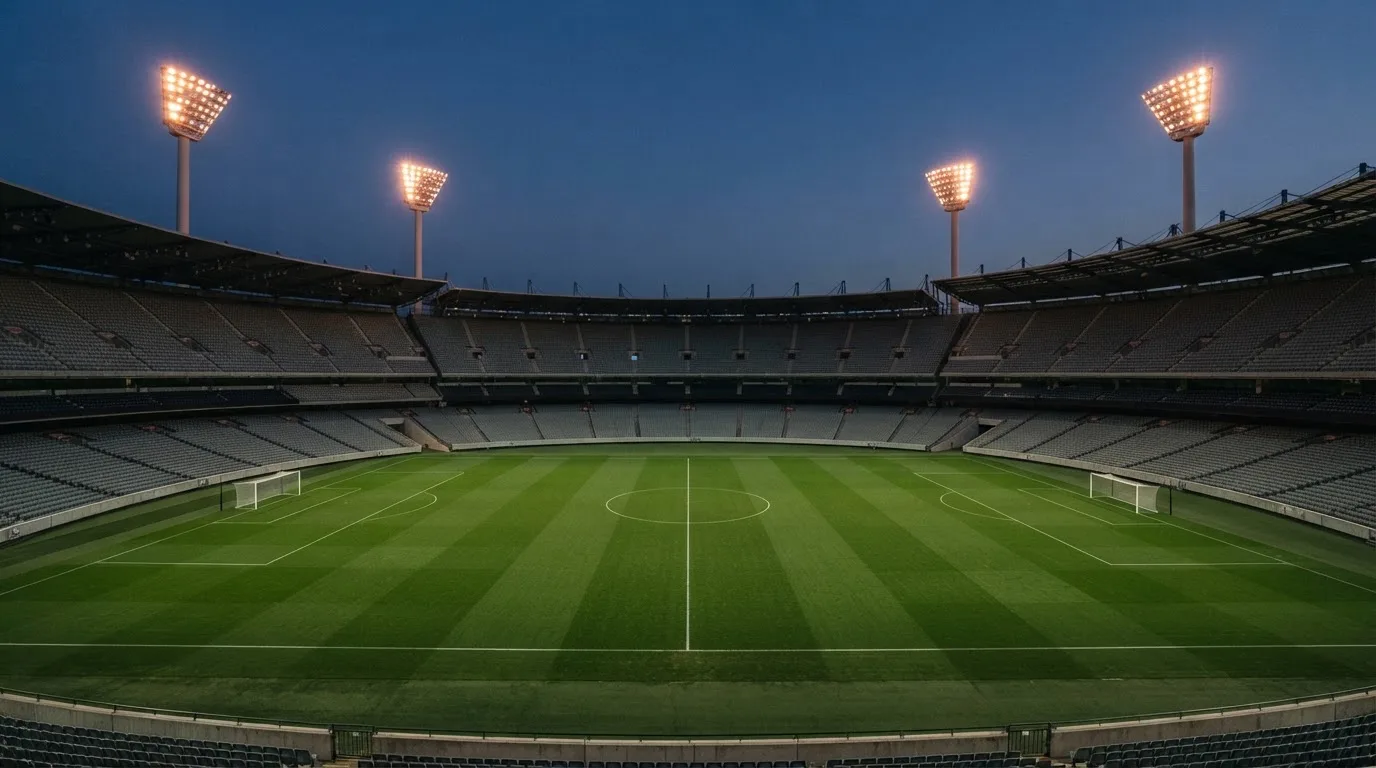
A football match is two halves of 45 minutes each, with stoppage time at the referee’s discretion. A tied match may go to two further 15-minute periods — “extra time” — and some competitions then settle the tie with a penalty shoot-out. Each team has a maximum of eleven players on the pitch, including the goalkeeper, and the goal is 7.32 m wide and 2.44 m high. The Laws of the Game are maintained by the International Football Association Board (IFAB), which has done so since 1886.
These are not atmospheric details. A bettor who treats extra time as part of the 90 minutes loses money on a settled match that goes to penalties. A bettor who forgets that the goal is two metres and change high prices a “top-corner” market incorrectly. A bettor who treats a substitution as part of a player’s “minutes played” line overpays for a market that counted the player as on the pitch only while they were on it. Most rules of football are not in the odds — but the odds are settled against the rules.
What “the 2026–27 season” actually means
The 2026–27 Premier League season runs from 21 August 2026 to 30 May 2027, with twenty teams and Coventry City, Ipswich Town and Hull City the promoted clubs in this cycle. Arsenal is the defending champion going in. The 2026 FIFA World Cup final, played on 19 July 2026, was won 1–0 by Spain against Argentina after extra time, so the international side of the football calendar has just reshuffled.
A few odd things to know: the season label carries two years because the league runs across them. A bettor who searches by the wrong year — “2026 Premier League” for a match played on 7 April 2027 — still gets the right page, but a bettor who searches “2027” for an August fixture sees the previous season’s results and forms an opinion on the wrong squad. The same goes for international breaks, European club competitions and cups whose finals sit late in the calendar.
Where a tip begins and ends, and why a guide is not a tip sheet
The phrase “football betting tips” is short, common, and means different things to different readers. A tip sheet is a list of picks: “Wolverhampton to win”, “over 2.5 goals”, “Haaland to score”. Each pick carries a price and a short reason — form, statistics, the line-ups, the market’s own odds. A tipster is a person or a service that publishes those picks, usually for a fee. A guide is none of those things: it explains how a tip is built, why the price the tipster publishes is not the same as the true probability of the event, and what a tip costs the punter when it goes wrong.
This is the page written. There are no picks here. There is no “back this, lay that”, no “today’s over 2.5”, no “tip of the day”. Every working tip has a price attached to it; every working tip is wrong at some point in a long enough sequence; every working tip carries a margin that the bookmaker paid for in advance. A reader who wants the picks is being misled by the absence of one: the picks are not the page’s content because the page is not a tip sheet. The picks are the work of a paid tipster and outside the scope of a free guide.
How a working tip is built
The honest version of a tip is a four-step build. First, the form: recent results, scoring patterns, clean sheets. A team that has won four of its last six at home is a different input than a team that has won one and lost four of its last six anywhere. Second, the squad: who’s injured, who’s back from injury, who is suspended. Manchester City without Rodri is a different proposition than Manchester City with him, and the price moves before the tip prints. Third, the context: this is a derby, this is a dead rubber, this is a European fixture with a second leg next week. Fourth, the line: the bookmaker’s own odds are an input, not an output. A bookmaker’s price is a probability adjusted by a margin, and the line on a given market is where the market thinks the event sits.
From those four steps, a tip emerges: “Wolves to win or draw at home to Manchester United”. A price sits on the tip: 6/4 on the double chance. The probability of the tip, in the tipster’s view, is whatever the tipster’s model says — which is rarely published, which is rarely the same as the bookmaker’s, and which is rarely met in a single bet.
What a value bet means in plain terms
A value bet is a price higher than the true probability of the event, after the bookmaker’s margin is taken out. Two prices sit on every market: the price the bookmaker offers, and the price a model assigns to the event. A value bet is a price-paid-larger-than-the-model. The arithmetic is one line. A 50% chance event priced at 6/4 (decimal 2.50) is a value bet, because 2.50 × 0.50 = 1.25: the bookmaker pays more than fair over many such bets. A 50% chance event priced at 1/1 (decimal 2.00) is also a value bet at smaller margin, because 2.00 × 0.50 = 1.00 sits at fair. A 50% chance event priced at 4/6 (decimal 1.67) is not a value bet: 1.67 × 0.50 = 0.835, less than fair, and the bookmaker takes the difference over many such bets.
No price is a value bet in isolation. The price is a value bet only against a model’s probability. The model is not a tip: the model is the reason a tip is published, and a tip published without a model is a guess.
Why no tip is ever certain
The honest framing is short: every tip is a probability, every probability can be wrong, and the bookmaker’s margin is on top of the probability. A tipster who calls 95% probability on 11/10 (decimal 2.10) is calling a value bet; the same tipster calling 95% on 1/20 (decimal 1.05) is calling a near-certainty. The first is a bet to take at a discount. The second is a near-certainty that pays like a near-certainty — the bookmaker’s price already reflects the 95% probability, and the value is not where the tipster said.
Three things follow. First, no tip is ever certain, because every tip is a probability and probabilities are not certainty. Second, every tip carries a margin that the bookmaker has already taken out — the price is never the true probability. Third, the longer the tip’s horizon — a season, a manager’s tenure, an injury — the wider the margin of error, and a tip priced on a 6-month horizon should be priced on a 6-month model.
Staking and bankroll — what every tip does to the punter
A bankroll is the money set aside for betting, kept separate from rent and food and the rest of the money that pays for life. A punter who keeps a bankroll of £500, places bets at £10 a tip, and uses the bookmaker’s price as the model is losing about £5 for every £100 bet on a market with a 5% margin (500 in bookmaker margin across £10,000 in stakes, or £5 per £100). A punter who models the probability themselves and only places a value bet is making more, on average, but is taking on a model-error tax. The two together — bookmaker margin and model error — are why tips lose over time.
Three rules from the practice of betting. First, never stake more than 5% of the bankroll on a single tip, because 20% draws a bettor to ruin and 10% draws a bettor close to it. Second, never chase a loss by raising the stake, because the next tip does not know about the last. Third, keep records of every tip, every stake and every outcome, because a model that cannot be checked is a model that cannot be beaten.
Why every tip ends in “bet no more than you can afford to lose”
The phrase is a regulatory one. The Gambling Commission requires it on every advertisement. It is also a literal one: a tip that loses is a stake lost, and a stake lost is money not spent on groceries. A tip is a bet. A bet is a probability with a price. A probability with a price is not a wage.
Legality and what a GB licence actually buys
[Image: An empty courtroom with wooden benches in morning light. Caption: A tied football match may go to extra time of two further 15-minute periods, and some competitions then use a penalty shoot-out.]
A bookmaker serving customers in Great Britain needs a Gambling Commission licence wherever it is based, under sections 33 and 36 of the Gambling Act 2005 as amended by the Gambling (Licensing and Advertising) Act 2014. A Curaçao, Maltese or Gibraltar licence is not a substitute; a brand can be authorised in those jurisdictions and still need a separate GB licence to take a stake from a customer in England, Scotland or Wales. Northern Ireland sits outside the 2005 Act on older law, so the right term is “GB-licensed”, not “UK-licensed”.
The Commission’s public register is searchable by business name, trading name, domain or account number. It carries every remote operating licence granted under the Act and is the bare test of who is licensed. The ten brands on this page — Betway, BetUK, 10bet, LiveScore Bet, London Bet, Kwiff, William Hill, Kalooki Sportsbook, Sporting Index and Tote — all appear on the register with a remote general betting standard (real events) category, and Sporting Index additionally operates under the Financial Conduct Authority’s regime for spread betting. None of the brands is the only licensed operator, none of them is the only one licensed for football, and the register lists far more brands than this article features. The list of ten is editorial, not regulatory.
What “remote general betting standard” means in the licence line
The Commission’s licences break into five categories for remote betting: general betting standard (real events), general betting standard (virtual events), general betting limited, pool betting and betting intermediary (the exchange licence). Every brand on this list holds the real-events category — the one that covers football — and Sporting Index additionally holds FCA authorisation because spread betting that is a financial instrument is regulated outside gambling law.
What the category does not say is whether the brand offers football. A brand licensed for real events may choose not to list football at all, and a brand licensed for virtual events cannot take bets on a real match. The category is the legal authorisation, and the actual betting catalogue is the operator’s choice within it.
In-play markets — what’s allowed, what’s controlled
GB bookmakers offer in-play betting as a matter of routine. The legal controls are the operator’s licence conditions and the customer’s protection rules: in-play is not “unrestricted” as a legal conclusion, but it is available. A bettor who places a bet during a match does not get a different consumer protection because the match is in progress; the same GAMSTOP opt-out, the same deposit limit, the same complaints route apply.
Two practical consequences. First, the price on an in-play market is more volatile than the pre-match price, because the bookmaker’s model has less time to react and the margin gets rebuilt each time the goal odds adjust. Second, the operator’s cash-out feature — a button on every in-play slip that pays a stake back early at a derived price — is a contract the punter signs when they press it, not a binding price the bookmaker must hold. The cash-out button is a way out of a position, and the price is the cost of taking it.
Pool betting, exchanges and spread betting — three licences that look like one
Pool betting has its own licence: the off-course pool product is a dividend rather than a price. A bettor in a Tote pool takes a share of the pool minus the operator’s cut, and the winning payout depends on what other bettors staked. A betting exchange has its own licence too: Betfair, Smarkets and a handful of others run an exchange where one customer backs and another customer lays, and the exchange takes a commission rather than a margin. Spread betting sits in two places: financial spread betting is regulated by the FCA, and other spread betting sits under General Betting Duty with the rest of gambling.
For a football punter, the practical distinction is which product sits under what rules. A bet on Betfair is between two customers; the exchange takes a commission. A spread bet on Total Goals is a stake on how many goals are scored, where the punter is right about the margin as much as the direction. A Tote bet on a horse race is a share of a pool. The price model is different in each case, and the consumer protection sits in a different place too.
Bonuses, what’s allowed and where the line sits
Wagering requirements on bonuses are capped at 10x. A £10 bonus with a 50x wagering requirement needs £500 of bets to clear; under the 10x cap, the same £10 bonus needs at most £100 of bets. Mixed-product promotions — an offer that demands gambling on two or more product types, such as “bet on football to get free spins” — are banned. The rules took effect on 19 January 2026 and apply to every GB-licensed operator. Whether the cap covers free bets with no wagering condition, and any cap on the money value of a bonus, are not settled rules: the wording is what it is.
The cap is a small but real consumer protection. A bookmaker that offers £100 in bonus with a 10x turnover requires £1,000 in bets before withdrawal; a bookmaker that offered the same £100 with a 50x turnover required £5,000. The 10x cap pulls the worst offers into a corridor the punter can actually clear. It does not make bonuses good value. Bonuses are still bonus-credit on which the margin is taken, and the wagering cash is the punter’s money turning over for the operator’s benefit.
The offshore side — what a non-GB licence means in plain English
A brand without a GB licence is not, by definition, a fraud. It is an operator licensed elsewhere — Curaçao, Malta, Anjouan — that does not hold the licence the Act requires to take bets in Great Britain. The honest framing is what is lost, not what is illegal. An offshore brand is outside GAMSTOP, so the self-exclusion tool a customer has set up does not cover it. An offshore brand is outside the Commission’s complaints route, so a customer whose funds are withheld has no UK redress. An offshore brand is outside the 10x cap and outside the £150 financial vulnerability check, so the consumer protections attached to a GB licence are gone. None of this is a crime by the customer. The Act aims at the operator under section 33 — up to 51 weeks’ imprisonment, a fine up to level 5, or both on summary conviction, six months in Scotland — and enforcement is disruption: cease-and-desist notices, search-engine referrals, work with registrars, hosts and payment providers, with court-order DNS blocking powers given, or being given, to the Commission. The line for the punter is the same as it has always been: a GB licence is the test of who is regulated, and the regulated route is the route that costs less when things go wrong.
Safer gambling — what the framework gives a punter, and what it doesn’t
The Responsible gambling cluster is a structural part of this guide for two reasons. The first is that the Commission’s safer-gambling rules are licence conditions, not options: every operator on the list has GAMSTOP in place, offers deposit limits, runs age and identity verification, and is signed up to the safer-gambling help services. The second is that the rules have hard edges the marketing pages do not advertise.
GAMSTOP is not the same as a betting-shop ban
GAMSTOP is the national multi-operator online self-exclusion scheme. Online sites and apps have been covered since 31 March 2020; betting shops use a separate multi-operator self-exclusion scheme. Periods are six months, one year, five years, or five years with auto-renewal; after the minimum period, the exclusion stays for a further seven years unless the customer asks GAMSTOP to remove it. A punter who has self-excluded at one online bookmaker is self-excluded at every online bookmaker in the scheme. A punter who has self-excluded at a betting shop is not, by that act alone, self-excluded online.
The £150 financial vulnerability check — what it is and what it isn’t
The Commission’s LCCP condition 3.4.4, in force since 30 August 2024, applies to remote betting when a customer’s gross deposits minus withdrawals exceed £150 in a rolling 30-day period (since 28 February 2025). The check is a public-record check — bankruptcy, county court judgments, similar registers. It is not an income check; it is not a credit-reference check. A punter who crosses the threshold is asked, in simple terms, whether they can afford to keep betting at the rate they are betting, and the operator is allowed to use the public-record check as a starting point.
Financial risk assessments — what the press calls “affordability checks” — are announced, staged, and have no start date. The Commission’s policy paper of 7 July 2026 sets out the framework; operators are not yet required to run the assessments on demand. Until a Commission notice fires the requirement, the £150 check is the only check running, and the difference between the check and the assessment matters when a punter reads an explanation in the press.
Deposit limits — what they are, what they aren’t
Operators must offer a gross deposit limit on a fixed time frame (Remote Technical Standard 12). The first changes applied on 31 October 2025; a second phase has been postponed to 30 September 2026, and whether it is now live has not been established. Limits are the customer’s choice, not the regulator’s ceiling: there is no state-set deposit or loss cap for betting at a licensed operator. A punter who sets a daily deposit limit of £50 has a £50 ceiling; a punter who sets no limit has no statutory ceiling at all, only the operator’s own stake-by-stake controls.
Help services — who answers, and how quickly
GamCare runs the National Gambling Helpline. GambleAware funds education and treatment. The NHS runs specialist gambling clinics across the regions of England. Gamblers Anonymous runs peer-support meetings in person and online. GAMSTOP itself is the self-exclusion service, not a helpline. A punter who needs help has a working phone line, a working set of regional clinics, and a working set of meetings, and the Commission’s safer-gambling pages link to each.
The words “stay in control” and “gamble responsibly” appear on every GB-licensed operator’s footer. They are not a safeguard — they are a requirement. The safeguard is GAMSTOP, the deposit limit, the financial vulnerability check and the complaints route. A punter who has used any of those is using the framework; a punter who has not is a punter the framework does not yet know about.
Crypto and anonymity — where the framework puts a pin
No licensed GB bookmaker takes anonymous stakes. Identity verification — name, address, date of birth — is the gate, in force since 7 May 2019, and it applies before a customer can deposit or gamble, including with a free bet or bonus. A punter who wants to bet without verification is a punter who needs an unlicensed brand, and the previous cluster is what that costs.
A licensed bookmaker that took crypto would have to verify the source of funds, which is the same task the AML regime sets for fiat. The Commission’s stand on crypto is not a ban: it is a “no official position, no licensed operator known to take it” reading. A punter who sees a “crypto football betting” offer is being routed to an unlicensed brand, with the consumer-protection consequences set out two clusters up. The risks of crypto as a payment rail — price volatility, irreversible transactions, exchange outages — sit on top of the gambling risks and are not the bookmaker’s risk to manage.
Bonuses and free bets — what the marketing picture really costs
The phrase “free bet” is a marketing one. A free bet, under any of the ten brands on this page, is a token — not a cash credit, not a stake the punter keeps. A free bet’s stake is usually not returned with a win. A £10 free bet at 5/1 (decimal 6.00) returns £50 in winnings plus nothing of the £10 stake; the punter walks away with £50, not £60. The bookmaker has paid the winnings; the punter has had the bet; the difference is which side of the cash register the stake sits on.
A free bet’s value, on average, is the free-bet amount × (odds − 1) ÷ odds × the market’s payout share. For a £10 free bet at 5/1 on a market with a 95% payout share, the value is £10 × (6.00 − 1) ÷ 6.00 × 0.95 = £7.92. That is the average over many such bets, not the winnings on any single bet. A free bet at long odds on a thin market is a different proposition than a free bet at short odds on a deep market, and the long-odds free bet is often the better value — but only because the £7.92 average is one of the rare arithmetic sentences on the page where the long odds help the punter, not the bookmaker.
What rollover looks like — and what it isn’t
A rollover, or wagering requirement, is a multiple of the bonus that has to be turned over in qualifying bets before the bonus (and any winnings from it) become withdrawable. A £10 bonus with a 10x wagering requirement needs £100 of bets; a £10 bonus with a 5x rollover needs £50. The Commission’s 10x cap, in force since 19 January 2026, draws a line at the upper end. The cap is a corridor for the operator’s worst offers; the lower the rollover, the quicker the bonus clears, and the less margin the bookmaker takes from the rollover stake.
What rollover looks like in a marginal-cost sense: turnover × margin of the market = expected loss while clearing. A £100 turnover on a market with a 5% margin costs £5 on average. A £1,000 turnover on the same market costs £50 on average. The punter who needs to clear £100 to extract a £10 bonus spends about £5 of expected stake margin; the punter who needs to clear £1,000 spends about £50. The arithmetic is the same in both cases. The bonus is the bonus; the cost is the cost.
What a minimum odds rule does
A “minimum odds” rule on a free bet or a qualifying bet — minimum odds 2.0, minimum odds 1/2, minimum odds 5/1 — is a filter on which markets the punter is allowed to use the bonus on. A rule that requires minimum odds 2.0 funnels the punter to outrights and underdogs; a rule that requires 5/1 sends them to longshots; a rule that requires 1/2 keeps them on favourites. The rule does not say “the bookmaker likes you to lose”; the rule says “the bookmaker prefers the punter to bet on markets where the margin is wider”.
Deposit-gated offers versus no-deposit offers
A deposit-gated offer pays out after the punter’s first deposit of £10, £20 or £50, and the bonus is gated to a stake the punter has actually placed. A no-deposit offer pays out after registration, without a deposit. Both are “free bets” in the marketing language. The difference is what the punter commits before the bet lands. No-deposit offers are rarer in 2026 than deposit-gated ones, because the Commission’s safer-gambling rules and the bonus cap make no-deposit an awkward product to run. A punter who treats a no-deposit offer as a free trial is using it the way the operator wants the punter to use it.
The “boosted odds” promise
A boosted odds offer pushes one specific selection’s price above the bookmaker’s normal quote — “Arsenal to win, boosted from 4/5 to 6/4”. The price still carries a margin; the boost is a fraction of the margin returned to the punter as marketing spend. A boosted price is a price, not a value bet: the same selection at unboosted 4/5 (decimal 1.80) on a market with a 5% margin is roughly 5/6 (decimal 1.83) on fair odds; the boosted 6/4 (decimal 2.50) is generous. Whether it is value depends on the model’s probability of the event. A punter who places a boosted price on every selection they would have placed anyway is collecting the marketing spend; a punter who chases boosted prices on selections they would have skipped is paying the marketing spend with extra stake.
What “risk-free” really means
The phrase “risk-free bet” in marketing language usually means a bet whose loss is refunded as a free bet. The word “refund” misleads: the punter is not given back the lost stake; the punter is given a free bet whose stake is not returned with a win. A £20 risk-free bet that loses pays back £20 in free bets whose expected value is £15.84 on a market with a 95% payout share. The risk-free label is honest about the original stake; it is silent about the value of the refund. The Commission has not banned the term, and the LCCP does not impose a definition; the term is a marketing one, used as the marketing one uses it.
Mobile and the apps that carry the bets
Every operator on this page runs a mobile app, either through the App Store (which is where the version detail in research lives) or through the operator’s own download. The features differ; the margin of difference is rarely the app’s. An app is a delivery channel for the same markets, the same prices, the same account. A punter who judges an app by what it looks like is judging the chrome, not the engine.
Three points on the apps that matter.
Speed of the in-play slip
A live-bet slip is a fast-moving widget: the price updates every second, the bet is one tap away, and the slip is the only place the punter and the bookmaker are talking in real time. The fastest apps — LiveScore Bet (whose product sits on the LiveScore scores backbone), 10bet (whose in-play tab is a stripped-down market list) and Betway (whose tab is the long-tenured default) — are the three to compare on a Saturday. The slowest apps are usually the slowest because of margin-protection: the price on a market that updates by the second refreshes less often, which protects the bookmaker’s price more than it protects the punter’s experience.
Search, market depth and how the app finds the bet
A football market is not a single selection: it is hundreds of selections, across match result, double chance, both teams to score, over/under goals, handicaps, correct score, player markets, corners, cards, combination bets. The app’s search, the way it orders fixtures, and the way it orders markets inside a fixture decide whether the punter finds the bet in five taps or five minutes. 10bet’s Bet Builder is a same-game multi on a single fixture; Betway’s tabs divide the match into phase-by-phase tabs; Kwiff’s Supercharge can apply after the bet is on the slip. None of the differences is structural — all of them are convenience, and convenience is what the chrome does.
Notifications and limits set inside the app
A punter who sets a deposit limit inside an app spends five seconds doing so; a punter who does not has not set the limit at all. The Commission’s safer-gambling requirements make the limit-setting prompt visible on every licensed app; the limit is the punter’s choice, not the regulator’s, and the setting is right there. Notifications — about boosted odds, about price drops, about result confirmation — are settings the punter can manage. A punter who treats the app’s notifications as if they were friend requests from a brand is mistaking the chrome for the relationship.
Live betting and cash out — how the slip changes during a match
The live betting tab is a different product than the pre-match product, and the difference is the margin. Pre-match, the bookmaker has hours to set a price; live, the bookmaker has seconds. The model that prices the pre-match market still prices the live market, but it does so with less data, less time, and a more cautious margin. A live price is a price that has been built quickly, is moved quickly, and pays the bookmaker back faster than the pre-match counterpart.
What cash out costs in plain English
The cash out button is the slip’s exit door: place a bet, watch the price move, press cash out and take a derived price set by the bookmaker. The derived price is the bookmaker’s view of the bet’s current value, less a margin. The margin on a cash-out is rarely published and varies by event, by score, and by the time remaining. A punter who presses cash out at the right time is taking a margin-gifted price; a punter who presses it at the wrong time is paying the bookmaker for an exit the punter did not need.
Three things to know. First, cash out is a contract: pressing the button settles the bet at the derived price and ends the position. Second, the derived price is the bookmaker’s, not the market’s: it is an internal valuation with the bookmaker’s margin built in. Third, the same cash-out price can vary by seconds — the price is moving, and the punter who waits half a second for a better price is gambling against the model in real time.
In-play price behaviour and the rhythm of a match
The match is a clock: the start of each half, the goal moments, the red cards, the substitutions. The price moves fastest in the first five minutes and the last five. The margin on a live market is wider in those windows because the bookmaker has less to anchor on. A punter who bets live on a first-five-minutes goal is paying a margin heavier than the pre-match margin, and is pricing the moment as much as the event. A punter who bets live on a 70th-minute lay of a leading underdog is paying a margin that has widened because the bookmaker is protecting against the comeback the model does not believe in.
Suspended markets — what “bet suspended” actually means
A market that has gone “suspended” mid-match is a market the bookmaker has temporarily closed because a key event has happened — a goal, a red card, a substitution. The bookmaker reopens the market at a price that reflects the new state of play. The punter who wants to bet into that suspension is not a punter who can; the suspension is the bookmaker’s risk-management tool, and the punter accepts the reopened price or does not bet. There is no “bypass” for a suspension, and no way to bet into a market the operator has closed.
The bookmaker’s margin — the one figure every page needs
The bookmaker’s margin is the cut the operator takes from every market. It is the difference between the price the punter pays and the price the punter would pay on a fair market. It is built into every decimal price, every fractional price, every selection on every market, on every bookmaker.
How the margin is calculated
The margin on a two-way market is one minus the payout share, and the payout share is one over the sum of the inverse odds. Take an illustrative two-way market at decimal 1.90 / 1.90 — even money on each side. The payout share is 1 ÷ (1/1.90 + 1/1.90) = 1 ÷ (0.5263 + 0.5263) = 1 ÷ 1.0526 = 0.95. The margin is 1 − 0.95 = 0.05, or 5%. For a market quoted at 1.90 / 1.90 the bookmaker keeps 5p of every £1 bet, on average, across both outcomes.
The margin is on top of the actual outcome probability. A 50/50 event with a 5% margin prices at 1.90 / 1.90, not at 2.00 / 2.00. A 60/40 event with a 5% margin prices at about 1.59 / 2.63, not at 1.67 / 2.50. The margin moves the price on every selection, in every market, on every bookmaker.
The margin is a band, not a number
The 5% figure above is illustrative. Real-world football margins depend on the market, the bookmaker, the event, and the betting volume on the run-up to the match. The pre-match 1X2 margin on a Premier League fixture is typically tighter than the in-play 1X2 margin, and both are wider than the Asian handicap margin on the same fixture for a sharp bookmaker, and wider than the over/under 2.5 margin on the same fixture for a wide bookmaker. The margin is a band per market per bookmaker per event, not a single number a brand carries across all its markets. A punters reading a bookmaker’s “5% margin on football” banner has read a marketing line, not an arithmetic one.
Why the margin makes every bonus worse than it looks
The bonus is the marketing spend; the rollover is the wagering requirement; the margin on the rollover’s qualifying markets is the cost. A £10 bonus with a 10x rollover needs £100 of bets; the £100 of bets sits inside markets whose margin is the bookmaker’s cut; the cut is the punter’s cost. A 5% margin on a £100 turnover is £5 of expected cost; a 7% margin on the same turnover is £7; a 3% margin on the same turnover is £3. The punter who picks a high-margin bookmaker to clear a bonus is paying more for the same bonus than a punter who picks a low-margin bookmaker. The difference between the two is the arithmetic the bonus page does not print.
The arithmetic is the same in every currency and every odds format
The 5% margin is the same 5% whether the price is quoted as 1.90 decimal, 10/11 fractional, or -110 American. The odds format changes the readout; the margin is the same underlying cut. A punter who switches bookmakers because of a price-format preference has not improved the margin; a punter who switches bookmakers because of a price change has. The odds are a window; the margin is the curtain behind the window.
Bet types and odds — the shape of a slip
A football bet is one of three shapes: a single on one selection, a multiple on two or more selections whose odds multiply, or a system bet that covers combinations. Each shape prices differently, settles differently, and is taxed differently by the bookmaker’s margin.
Single bet
A single is one selection at one price. The stake pays back stake × odds on a win, and the profit is stake × (odds − 1). A £10 single at 5/1 (decimal 6.00) pays back £60 on a win, the profit is £50, the loss on a non-win is the £10 stake. The margin on a single is the margin of the one market.
Accumulators (“acca”)
An accumulator is a multiple: every selection must win for the bet to win, and the odds of the legs multiply. A £10 four-fold at decimal 1.50, 1.80, 2.00 and 2.50 pays back £10 × 1.50 × 1.80 × 2.00 × 2.50 = £135 on a win, profit £125. The margin on the accumulator is the composite of every leg’s margin, and is wider than the margin on any single leg. The wider margin is the cost of compounding the price.
A bet builder (“same-game multi”) is an accumulator on a single match. The odds multiply across markets within one fixture, and the margin on the composite is wider than on any one market in isolation. 10bet’s Bet Builder and Kwiff’s Supercharge are both products built on accumulator-shaped slips, and both carry composite-margin costs the punter does not see in any one price.
Each-way bets
An each-way bet is two bets of equal stakes on one selection — one on the win, one on the place. The place terms are bookmaker-specific, race-specific and field-specific; a horse race with eight runners pays a quarter of the win odds on the place; a race with five runners pays a fifth; a race with twelve runners pays a quarter. The total stake is double the unit stake: a £10 each-way on a horse is a £20 stake, £10 on the win and £10 on the place. The bookmaker’s margin is the margin of two markets, not one.
Handicap bets
A handicap bet is a match bet where one side starts the match with a goal advantage or disadvantage. A -1 handicap on the favourite pays back at higher odds because the favourite must win by two; a +1 handicap on the underdog pays back at lower odds because the underdog only needs to draw. Asian handicaps are split handicaps — a -1.5 is half the line, a -1/1.5 is split between -1 and -1.5 — and the pricing reflects the half-line. The margin on Asian handicap markets is typically the tightest margin a sharp bookmaker offers on a football fixture.
Over/under, BTTS, correct score
An over/under bet is a bet on the total of a count — goals, corners, cards. The market is two-way: over or under the line. A 2.5 line is the most common on football; over 2.5 wins if three or more goals are scored, under 2.5 wins if two or fewer. Both teams to score (BTTS) is a yes/no market on whether each team scores at least once. Correct score is a multi-way market on the exact score at full time, with one selection per 0-0, 1-0, 1-1, 2-0, etc. The margin widens with the number of outcomes, and correct score is a wide-margin market against which a punter’s model has a thin case to argue.
Cash-out and lay bets
A lay bet is a bet against a selection winning: the punter pays the backer’s stake if the selection wins and keeps the backer’s stake if the selection loses. Lay bets are an exchange product, not a bookmaker product, and they require a betting exchange account. The 10 brands on this list do not run an exchange, and a punter who wants to lay a selection at a fixed-odds bookmaker cannot. Cash-out is the closest equivalent for fixed-odds: a backer’s exit at the bookmaker’s derived price.
Sports, tournaments and the football calendar
Football is the dominant betting vertical on this page, and the calendar shapes every operator’s catalogue. The Premier League season runs from August to May with 20 teams; the season-ticket product is the football calendar’s spine, and a £10 bet on a Saturday afternoon is the typical stake on the typical market. The Champions League runs from September to May; the Europa League from September to May; the World Cup runs every four years in summer, with qualifiers running the rest of the cycle. The 2026 World Cup final was won by Spain against Argentina in July 2026, and the 2026–27 European club season opens with the Premier League on 21 August 2026.
What the season label buys
The season label — 2025/26, 2026/27 — is the calendar’s spine. A fixture played on 6 April 2027 is in the 2026/27 Premier League season; a fixture played on 28 August 2026 is also in that season; a fixture played on 13 May 2026 is in 2025/26. Cup competitions can carry a different cycle — the FA Cup final sits in May, the EFL Cup final in February or March, the European Cup finals sit in May or June. The season label is not always the same as the calendar year.
Major international tournaments to know
The European Championship (Euros) and the World Cup sit on a four-year cycle each, with the two tournaments sitting two years apart. The 2026 World Cup is the most recent; the next European Championship is in 2028. Copa América is a separate cycle, again on a four-year rhythm. These tournaments draw a different shape of market — outrights on the winner, group-stage markets, top scorer markets, markets on individual matches that carry a different margin than the league equivalent. Margins on cup fixtures are typically wider than margins on league fixtures because the volume of betting is concentrated in the first week and the last week of the tournament.
What a tier of football looks like
Football has tiers. The Premier League, Championship, League One and League Two sit in England; the Scottish Premiership sits below them in volume but above them in some smaller markets. The Championship runs 24 teams; League One and League Two run 24 teams each; the National League runs 24 teams at tier five. The Scottish Premiership runs 12 teams. The European top-flight leagues — La Liga, Bundesliga, Serie A, Ligue 1 — sit as parallel tiers in their own national calendars. The margins tighten on the volume leagues and widen on the tier-three and tier-four leagues; a punt bet on League Two has a wider margin than the same bet on the Premier League.
What a player market covers
Player markets are selections on individual players — first goalscorer, to score at any time, shots on target, assists, cards, tackles. The margin on a player market is wider than the margin on the match-result market because the model is harder and the data is sparser. A £10 first goalscorer bet on a single match is settling against one player’s minutes on the pitch and one model’s estimate of how often that player scores; the price is more cautious than the match-result price, and the punter is paying for that caution. Player markets are the sharpest part of an operator’s catalogue and the easiest to misread.
Predictions and strategy — what a working tip looks like under the hood
A working tip, in this guide’s framing, is a price-larger-than-the-model. The four-step build is the same as the one in the early section; this section is on what the build costs the punter and which tactics bookies look out for.
The bookmaker’s pricing is one input, not the answer
A bookmaker’s price is a probability adjusted by a margin, and the margin is the bookmaker’s cut. A model-built probability, sitting beside the bookmaker’s price, is the test of whether the price is a value bet. The bookmaker’s price is one input to the model; it is not the answer the model returns. A punter who treats the bookmaker’s price as ground truth has paid the margin twice — once on the bet, once on the model — and has lost on average.
Form, statistics, line-ups, odds — four inputs in order of narrowing
Form is the broadest input. A team that has won its last three at home is a different input than a team that has lost its last three at home. Statistics narrow the form: goals scored, shots on target, expected goals (xG), expected goals against (xGA), possession, pass completion. Line-ups narrow the statistics: which players are playing, who is injured, who is suspended. The line narrows further still: the bookmaker’s own line moves when the squad is announced, and the punter who has built the model up to the line has a sharper price than the punter who has built it up to the squad.
Rest, fixture congestion, and the variables form does not capture
Form is a 90-minute window of play; rest is a longer window. A team that played on Wednesday and is back on Saturday has a different recovery than a team that played on Sunday and is back on Saturday. Fixture congestion — a Champions League midweek, an FA Cup replay, an international break — is the part of form that form does not capture. A team that has played four games in ten days has played more football than its statistics suggest, and the model’s price on the eleventh day is a different price than the model’s price on the first day.
Home advantage is a fact, but a fact that contracts
Home advantage is the model’s broadest edge: a Premier League home side wins about 46% of matches, an away side wins about 29%, with the remainder drawn. The share is smaller in the Champions League, smaller still in La Liga and Bundesliga, where the home crowd factor is more muted. A model that does not adjust home advantage to the league is a model with a wide parameter that is wrong.
Why every tip’s horizon matters
A tip on a single match has a 90-minute horizon. A tip on a season has a 9-month horizon. A tip on a manager’s tenure has a horizon measured in transfer windows. A tip with a longer horizon is a tip with a wider error band and a slower settlement, and a punter who builds a model for a 9-month horizon is paying the cost of variance that an in-week model does not see. The horizon is not a footnote; it is the model’s calibration.
The operators, in their own words — what each one’s terms page says
Each of the ten operators above has a terms page, a brand voice, and a position in this list. The block below revisits each one with a sharper eye for the clause that costs the punter the most.
Betway — the seven-day timer
Betway’s £40 in free bet tokens (4 × £10) is a respectable free-bet headline for a debit-card punter. The 7-day expiry on each token is the clause that costs the punter most: a £10 token that does not settle in a week lapses, and a punter with three tokens sitting idle loses three £10 free bets in a quarter. The 2.0 minimum odds on the qualifying bet funnels the punt toward outrights and underdogs, and the e-wallet exclusion (debit card deposits only) cuts out the Apple Pay and PayPal customers whose wallets would otherwise be easier. For a debit-card punter who plans the Saturday and a couple of midweek accas, the offer clears. For anyone outside that shape, the seven-day window is the cost they pay.
BetUK — the exclusions list
BetUK’s free-bet offer is generous on football but excludes virtual sports, esports and non-UK/Irish horse racing. The exclusions are a marketing cost: the punter who heard about a £30 free bet on virtual football finds the door closed, the punter who heard about a £10 free bet on a Champions League fixture finds the door open. Minimum odds apply, so a qualifying £5 bet on a short-odds favourite settles but does not trigger the free bet. For a punter whose betting lives inside the English league game, BetUK is a clean offer. For a punter whose betting crosses into esports or non-UK horse racing, the same offer is a closed door.
10bet — the in-play + builder combination
10bet’s Cash Out, Bet Builder and Live Streaming are a solid trio for a punter who wants one app to cover pre-match, in-play and stream on a Saturday. The Bet Builder is a same-game multi on a single fixture; the Live Streaming is broadcast-quality on selected fixtures; the Cash Out is the slip’s exit. The trio together is rarer than the marketing line lets on, and 10bet’s catalogue of leagues is broader than a small bookmaker’s. The terms to read are the Cash Out suspension rules and the Live Streaming geo-restrictions: the first pauses the slip on a key event, the second cuts the picture outside the UK.
LiveScore Bet — the payment page
LiveScore Bet’s headline is its payment page — debit cards (Visa, Mastercard), Apple Pay, PayPal, Pay by Bank (Open Banking) and Revolut Pay. The breadth is rare among fixed-odds bookmakers and gives the brand a reason to be the punter’s primary wallet. The product sits on the LiveScore scores backbone, so the in-play fixture carries a live-scores overlay without leaving the slip. The football catalogue is broad; the Live Streaming coverage is gated to specific leagues. For a punter who wants one wallet across bookmakers, this is the choice. For a punter who wants the cheapest in-play margin, the comparison is elsewhere.
London Bet — the casino cross-sell
London Bet’s app combines a sportsbook with a Pragmatic Play casino wing, and a 17+ App Store gate. The combination is the brand’s position: a single download covers a football tip, an NBA tip-off and 200 slot spins. The Thistle Bet Limited ownership is a small-holder situation; the published terms are short enough to read in one sitting. The gamble-product breadth is the upside; the absence of a ClearMarket-style in-play product is the downside. For a customer who wants one app for everything, this is the product. For a customer who wants football only and nothing else, the casino wing is dead weight.
Kwiff — the Supercharge uncertainty
Kwiff’s Supercharge can boost the odds on a placed bet at the moment of stake — a £10 bet at 5/2 can become a £10 bet at 20/1 if Kwiff decides to boost it. The mechanic is honest about its random nature; the prize is the longer odds; the cost is the unpredictability. A punter who likes the lottery shape of a flutter that can pay more than the price quoted, and who has set a deposit limit accordingly, is using Kwiff as the product is meant to be used. A punter who treats the unboosted price as the price will not notice Kwiff has taken a margin on the underlying market, and the margin is the cost.
William Hill — the BOG headliner
William Hill’s Best Odds Guaranteed on UK and Irish horse racing from 8 AM on race day is the stand-out clause, applying on both single and multiple bets but excluding ante-post, tote and pari-mutuel. The football-side headlines are the acca insurance (a typical four-fold or five-fold refund as a free bet if one leg loses) and the in-play tab. The price on football matches is competitive; the price on racing is the headline. For a punter whose betting lives inside racing, William Hill is the account to keep open. For a punter whose betting lives inside football, the comparison is with the rest of the catalogue.
Kalooki Sportsbook — the small bookmaker’s edges
Kalooki Sportsbook is a small operator with three practical edges: instant withdrawals by bank transfer within minutes (a claim, not a tested observation); Best Odds Guaranteed on UK and Irish racing; in-play, daily boosts and extra-place races. The small scale is an advantage on terms readability — a single terms page holds the whole offer — and a disadvantage on football-market depth. The licence is verified, the verification is required before any deposit, and GAMSTOP membership is in place. For a punter who values a readable terms page and fast withdrawals, this is the bookmaker. For a punter who wants the broadest Premier League catalogue, the page count is on the bigger operators.
Sporting Index — the spread-bet twist
Sporting Index’s mixed welcome pack — fixed-odds, spread-bet and a £1 Race Index spread leg — is the differentiator on this page. The clause that bites is the in-play ban on the qualifying bet: a punter who placed the qualifier live gets nothing back, and a punter who cashed out the qualifier forfeits the bonus. The wagering terms sit on the fixed-odds side, where a 1/2 minimum odds rule on a £10 bet is a low bar. The spread-bet legs are the unusual product: a £5 Total Goals spread bet settles against how many goals are scored, not whether the punter’s side wins. For a punter who understands spread betting, the welcome is unusually broad. For a punter who does not, the spread legs are an extra bonus with an unusual settlement — and “extra” is the only honest word for a free bet whose loss can outrun its deposit.
Tote — the dividend model
Tote’s product is a dividend, not a price. The stake goes into a pool; the operator takes a cut; the rest is divided among winning stakes. The model’s economics are different: there is no margin in the price sense, because the price is the dividend the pool produces. The brand is the right home for a punter who likes the dividend model and is comfortable with the dividend’s variability. The brand is the wrong home for a punter who wants a single, transparent decimal price on a Premier League fixture — and the rest of this page is written against fixed-odds markets.
How the maths sits together — a worked margin on an illustrative market
The margin the bookmaker takes on a market is the sum of the inverse odds less one, all inverted. The arithmetic is short and the meaning is wider. Take an illustrative two-way market at 1.90 / 1.90 (fractional 9/10) — an example, not a quoted price. The payout share is 1 ÷ (1/1.90 + 1/1.90) = 1 ÷ 1.0526 = 0.95. The margin is 1 − 0.95 = 0.05, or about 5% on the bookmaker’s side. For a market priced at 1.95 / 1.95 the margin is closer to 2.6%; for 2.00 / 2.00 the margin is 0% and the market is fair; for 1.80 / 1.80 the margin is 11.1% and the bookmaker takes more of every pound.
The result is a band, not a number. The 5% figure above is a single illustrative market; real-world football margins on Premier League 1X2 are typically in the 2–7% band, with sharp bookmakers towards the lower end and recreational bookmakers towards the upper end. A punter who reads a “5% margin” headline as the brand’s number has read the example as the rule. The brand’s number is the average across its markets, and the average widens and tightens on every fixture. The condition behind the band is the market, the fixture and the bookmaker — never just the bookmaker.
The margin’s compounding with bonuses is the practical consequence. A £10 bonus with a 10x rollover needs £100 of qualifying bets; the £100 carries the margin of every market the bets land on; a 5% margin costs £5 of expected stake; a 7% margin costs £7. A punter who clears a bonus on the tightest-margin market available is paying less for the same bonus than a punter who clears the bonus on the widest-margin market. The arithmetic is the same; the cost differs. The cheapest place to clear a bonus is the lowest-margin bookmaker, with the lowest-margin market, with the lowest minimum-odds rule.
The margin’s compounding with accumulators is the second practical consequence. An accumulator’s odds multiply across legs; the margin compounds across the same legs. A four-fold of four 5%-margin legs is not a bet with a 5% margin; it is a bet with a 20%-margin on the composite price (1 − 0.95^4 = 0.185). The punter who builds an acca on four 5%-margin markets is paying about 18.5% of stake in expected loss; the punter who builds a single on any one of the four is paying 5%. The same selections, the same outcome, the same stake — and a four-fold costs about 14 percentage points more in expected stake. The marketing page does not print this number. This arithmetic reveals the hidden cost of the accumulator.
The expected cost of clearing a bonus is the page’s calculation: turnover × margin = expected loss. A punter who clears a £10 bonus with a 10x rollover on a market with a 5% margin pays about £5 of expected cost. A punter who clears a £100 bonus with a 5x rollover on a market with a 5% margin pays about £25 of expected cost. The bonus is the surface; the cost is the math.
Where the framework puts a pin — and where it doesn’t
The framework covers what a licensed operator must do, what a gambling transaction must look like, and how a punter’s data is handled. It does not cover the punter’s discipline on a Saturday afternoon. The framework provides tools the punter can use; the punter is the one who chooses to use them or not.
What the framework gives
A licensed operator gives GAMSTOP membership, age and identity verification, safer-gambling tools and a complaints route through an approved dispute-resolution body. The same operator gives a punt the terms page is published, the customer’s funds are segregated under the LCCP, and the bonus offering sits inside the 10x cap. The 10 brands on this page all carry those properties.
What the framework doesn’t give
The framework does not pick the punter’s tip, does not pick the punter’s stake, does not pick the punter’s bankroll size, does not pick the punter’s walk-away. The marketing language on every licensed operator’s footer is “gamble responsibly” and “stay in control”, and the words are not the safeguard. The safeguard is the deposit limit, the GAMSTOP opt-out, the financial vulnerability check at the right threshold, and the helpline that the framework funds. A punter who treats the framework as the safeguard and the marketing as the reality is paying a margin to forget the difference.
A note on tax
Betting winnings in Great Britain are not taxed on the player. The bookmaker pays General Betting Duty on gross profits — currently 15%, with a 25% rate on remote bets from 1 April 2027 — and the rate sits on the operator’s P&L, not the punter’s slip. Spread betting that is not a financial product is inside General Betting Duty; financial spread betting has its own rate. The Commission’s statutory levy is a separate charge, not a tax. A punter’s winning slip is a winning slip, net of stake, and no gambling tax sits on it.
The 25% rate, when it takes effect, is a remote-betting-specific number. Remote bets on UK horse racing, pool betting and in-person betting stay at 15%. Whether operators pass the duty on through odds is a question the industry has not answered publicly. A punter should not expect the 25% rate to lift or crush prices next April; the rate sits on the operator, and the price on the slip is the price on the slip.
How to use this page on a Saturday
Three practical frames for a punter using this page on a Saturday.
First, pick the bookmaker on the catalogue, not on the bonus. A bookmaker that covers the Premier League, Championship, Champions League and the European top-five with the market depth the punter wants is a better starting point than a bookmaker whose welcome bonus has the bigger number. The catalogue is the engine; the bonus is the chrome.
Second, set the deposit limit inside the app before the first bet. The 5% of bankroll on a single bet is the rule that survives Saturday. The deposit limit inside the app is the same rule written at the operator’s level. A punter who sets the limit before the first bet has the limit; a punter who does not is a punter the framework does not yet know about.
Third, read the terms on a free bet before clicking the claim button. The minimum odds, the exclusions (virtual, esports, non-UK racing), the cash-out suspension, the seven-day expiry, the debit-card-only clause — every clause is a cost the punter pays when they ignore it. The terms are two pages of small print; the reading is two minutes; the saving is the bonus.
Frequently asked questions
How do I actually bet on a football tip?
A football tip is a selection — a team, a scoreline, a goalscorer, an outcome — and the bet is the stake at the price. Place the stake inside the bookmaker’s slip, confirm the price the bookmaker is offering at the moment of placement, and wait for the event to settle. The tip is the prediction; the bet is the stake; the margin is the cut the bookmaker takes on top of the price the punter is offered. None of the three steps is hard. The work that betting pays for — the model, the value check, the discipline on stake size — sits behind all three.
How does a beginner start?
Start at the licensed bookmaker. Verify the account with name, address and date of birth before depositing. Set a deposit limit inside the app. Place a single bet on a market the punter understands — the result of one match — at a stake that is no more than 5% of the bankroll. Use the bookmaker’s terms, the safer-gambling tools, and the help services if the bankroll or the discipline slips. The Commission’s safer-gambling pages, GamCare and GAMSTOP are the working phone numbers; the rest is the budget and the calendar.
How do I bet on football online from the UK?
Open an account at a GB-licensed bookmaker — every brand on this list is one. Verify the account, deposit with a debit card or one of the bank-based or e-wallet methods the operator accepts. Bet on the market, the stake, the price. Settle the bet when the match ends. Withdraw through the same channel that deposited if the bookmaker allows it; instant withdrawals by bank transfer are the fastest lane at Kalooki Sportsbook and a growing number of other operators. The rest of the work is keeping records of stakes and outcomes.
What is a value bet and why is no tip ever certain?
A value bet is a price larger than the probability the punter’s model assigns to the event, once the bookmaker’s margin is taken out. The arithmetic is one line: price × probability > 1 for a value bet, < 1 for a bet the punter is paying for. No tip is ever certain because every tip is a probability with a margin on top, and probabilities can be wrong. The bookmaker's price reflects its own probability with its own margin; the punter's price reflects the punter's probability with no margin. A bet is a value bet when the punter's probability beats the bookmaker's enough to pay for the margin.
What is the bookmaker’s margin and how do I see it in the odds?
The bookmaker’s margin is the cut the operator takes of every market. The arithmetic is 1 − 1/(1/odds₁ + 1/odds₂ + …), summed over the outcomes of one market. A two-way market at 1.90 / 1.90 has a margin of about 5%; the same market at 1.95 / 1.95 has a margin of about 2.6%; a market at 2.00 / 2.00 has no margin. The margin is a band on every market, every bookmaker, every event; the punter sees the band as the implied probability the odds carry, and the difference between the implied probability and the punter’s own probability is the value.
How is a winning bet’s return worked out from stake and odds?
Return = stake × odds. Profit = stake × (odds − 1). A £10 single at 5/1 (decimal 6.00) pays back £60 in return (£10 stake + £50 profit) on a win; the loss on a non-win is the £10 stake. For a multiple (an accumulator or a bet builder), the odds of the legs multiply into one price; a £10 four-fold at 1.50, 1.80, 2.00 and 2.50 pays back £135 in return, with a profit of £125. The arithmetic is the same in every currency and every odds format, and the margin is the cut that sits between the price the punter pays and the price the punter would pay on a fair market.
Football – Inplayguide.com
Content created by the «Inplayguide.com» team
